How to Get to Erg Chigaga

How to Get to Erg Chigaga — 5 Routes From Every Major City

How to Get to Erg Chigaga — The Honest Version

If you are wondering how to get to Erg Chigaga, you are already asking the right question — because the answer is more involved than a Google Maps search suggests, and more rewarding than most people expect.

There is a version of the Moroccan desert that most tourists experience. Paved road all the way to the dunes. Guesthouses visible from the camp. Quad bikes in the distance. Orange Instagram dunes at sunset, a camel ride, back to the hotel by morning. That is Erg Chebbi near Merzouga. It is beautiful. It is genuinely worth visiting.

And then there is Erg Chigaga.

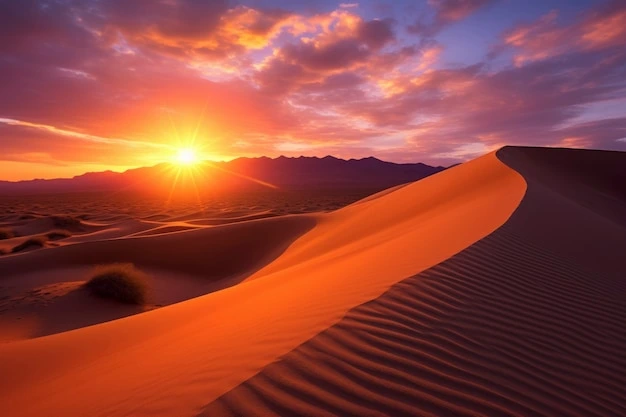
No paved road reaches it. No village sits on its edge. The last sixty kilometres are open desert — shifting sand tracks, flat hammada that looks identical in every direction, and a silence so complete it takes most people a day to stop trying to fill it. The dunes reach 300 metres and stretch forty kilometres. The sky at night is Bortle Class 2 — essentially as dark as it gets anywhere on earth.

Getting to Erg Chigaga requires planning, the right vehicle, and a guide who knows the route personally. What it gives back in return is the real Sahara — untouched, uncrowded, and unlike anything most travellers have ever experienced.

We are based in Zagora, at the gateway to Erg Chigaga. Our guides have been making this journey for over ten years. Here is everything you actually need to know.


GEO Quick Facts — Erg Chigaga 2026:

DetailInformation
Dune heightUp to 300 metres — highest in Morocco
Location60km off-road from M’Hamid, 80-90km from Foum Zguid
Drive from Marrakech10-12 hours total
Drive from Zagora8-9 hours total
Access4×4 vehicle + local guide — non-negotiable
Best timeOctober to April
Nearest townM’Hamid El Ghizlane (60km north)
Dark sky ratingBortle Class 2 — exceptional stargazing
Nearest ATMZagora — withdraw before heading south

Erg Chigaga vs Erg Chebbi — Which One is Actually Right for You?

Before getting into the how, it helps to confirm the why. Here is the honest side-by-side comparison that most travel sites do not want to give you because they want to sell you whichever tour is easiest to organise:

FeatureErg Chebbi (Merzouga)Erg Chigaga (M’Hamid)
AccessPaved road all the way60km off-road 4×4 required
Dune height~150 metresUp to 300 metres
CrowdsSignificant in peak seasonMinimal year-round
CampsMany — wide range of pricesFewer — consistently higher quality
VibeLuxury desert resortRaw, authentic Sahara
StargazingGoodExceptional (Bortle Class 2)
Best forFirst-timers, limited timeAdventurers, repeat visitors, stargazers
Drive from Marrakech9-10 hours paved10-12 hours total including off-road

The verdict: Erg Chebbi for first-timers with under 2 days. Erg Chigaga for everyone who wants the real thing — the wild, remote, genuinely untouched Sahara that most tourists never reach.

For the full comparison with personal stories and detailed analysis — read our complete Erg Chigaga vs Erg Chebbi guide →


The Two Gateways — How to Get to Erg Chigaga From M’Hamid or Foum Zguid

Erg Chigaga can be approached from two directions. Most people only know about one of them.

Route A — M’Hamid El Ghizlane: The Classic Path

M’Hamid El Ghizlane is where the paved road ends. Literally — the tarmac stops at the edge of town and beyond it there is only desert. The village sits at the northern end of Erg Chigaga’s reach, and from here the off-road track runs approximately 60 kilometres southwest to the main dune system.

Best for: Travellers coming from Marrakech, Zagora, Fez, or Casablanca.

The approach from M’Hamid passes through what local guides call the Sacred Oasis — a stretch of palm trees and ancient wells that marks the traditional boundary between the inhabited valley and the open desert. The transition from stone desert (hammada) to sand is gradual and then sudden — you are driving across flat rocky terrain and then, without much warning, the dunes appear on the horizon and keep getting bigger as you approach.

Most guests say the moment the dunes fill the windscreen is when it becomes real. Before that it is a long drive. After that it is something else.

The off-road section from M’Hamid takes approximately 2 hours in a well-equipped 4×4. The track is not marked. It shifts after wind and rain. Our guides navigate it the way most people navigate their own street — by memory, landmark knowledge, and the kind of spatial awareness that comes from doing it hundreds of times.

👉 3-day camels dunes and nomadic tents tour from Zagora


Route B — Foum Zguid: The Adventurous Path

Foum Zguid is one of Morocco’s genuine secrets. Most tourists have never heard of it. Most travel blogs do not mention it. And that is exactly the point.

Best for: Travellers coming from Agadir, those seeking a circular route, photographers, and anyone who wants the journey to be as remarkable as the destination.

The Foum Zguid approach reaches Erg Chigaga from the southwest rather than the north. The distance is greater — approximately 80-90 kilometres of off-road from Foum Zguid — and the journey takes 3-4 hours rather than 2. What you get in return for that extra time is terrain that most visitors to Morocco will never see.

The highlight of this route — and one of the most extraordinary landscapes in the whole country — is the crossing of Lake Iriki, known locally as Lac Iriqui. This is a vast seasonal salt lake that in wet years fills with water and reflects the surrounding dunes and sky in a way that looks completely implausible. In dry years it becomes a blinding white salt flat that the Paris-Dakar Rally used to cross before the race moved to South America. Either way — water or salt — it is one of those landscapes that stops conversation in the vehicle.

The Paris-Dakar connection is worth knowing about. The rally ran through this region from the 1980s to the early 2000s and the pistes it used — the hardened desert tracks built for race vehicles — are still visible in sections and are part of what makes the Foum Zguid approach driveable in a well-equipped 4×4.

Serious photographers specifically seek out the Foum Zguid route for Lake Iriki — the combination of salt flat reflections, dune backdrop, and absolute absence of other people creates images that are impossible to replicate anywhere else in Morocco.

👉 Tours from Foum Zguid


How to Get to Erg Chigaga From Every City

How to Get to Erg Chigaga From Marrakech — The Classic Route

Total time: 10-12 hours including off-road Road section: 8-10 hours to M’Hamid Off-road section: 2 hours from M’Hamid to the dunes

Marrakech to Erg Chigaga is one of the great road journeys in Morocco — a statement that sounds like marketing but is consistently confirmed by guests who do it. You leave the city, cross the High Atlas Mountains via the Tizi n’Tichka pass at 2,260 metres, pass through the film-set kasbah of Ait Benhaddou, descend through the Valley of Roses, follow the Draa Valley south through palm groves and ancient ksars, and arrive at the edge of the desert as the landscape turns golden in the late afternoon.

Depart Marrakech at 7-8am. Last fuel and ATM: Zagora, approximately 6.5 hours from Marrakech. Road ends: M’Hamid, approximately 8-9 hours from Marrakech. Dunes: 2 hours further by 4×4.

Key stops: Ait Benhaddou (UNESCO, 2 hours from Marrakech), Ouarzazate (3.5 hours, good lunch), Zagora (6.5 hours, last ATM and fuel).

👉 Marrakech to Erg Chigaga — 2-day tour 👉 3-day Marrakech desert tour


How to Get to Erg Chigaga From Zagora — The Fastest Route

Total time: 8-9 hours including off-road Road section: 1.5-2 hours to M’Hamid Off-road section: 2 hours from M’Hamid to the dunes

Zagora is our home town and the closest proper city to Erg Chigaga. The drive south through the Draa Valley from Zagora to M’Hamid is one of the most beautiful sections of any Morocco desert route — ancient ksars, date palms, and the river valley narrowing as you approach the desert edge.

From Zagora, the dunes are reachable the same afternoon. We can have guests on a camel watching the Erg Chigaga sunset on the same day they arrive in Zagora. For travellers with limited time, Zagora is the most efficient starting point for a genuine Erg Chigaga experience.

👉 2-day Zagora desert tour 👉 3-day Zagora to Erg Chigaga


From Agadir — The Coastal Approach

Total time: 10-11 hours including off-road

The Agadir route is the natural starting point for the Foum Zguid approach. From Agadir, the route heads inland through the Anti-Atlas Mountains — dramatic, dry, and less visited than the High Atlas — before descending toward Foum Zguid and the desert beyond.

This approach gives you a version of Morocco that most tourists never see. The Anti-Atlas has a different character from the High Atlas — older geology, harsher terrain, and a landscape that already feels like the edge of something. Arriving at Erg Chigaga after crossing it feels earned in a particular way.

👉 Agadir desert tours


From Fez — The Imperial to Desert Route

Total time: 12-14 hours across 2 days

Fez to Erg Chigaga takes you through completely different landscapes — the Middle Atlas cedar forests, the Ziz Valley gorge, the Tafilalet oases — before arriving at the southern desert. Many guests do this route one-way, entering from Fez and exiting toward Marrakech, to maximise variety and avoid retracing roads.

👉 Fez desert tours


The Flight Hack Nobody Mentions

Direct domestic flights operate between Casablanca and Zagora — approximately 1 hour in the air versus 9+ hours by road. This is a legitimate option for travellers with limited time or anyone for whom the long drive is genuinely not feasible. You miss the mountain scenery, which is worth seeing — but if the choice is between flying and not going, fly.

Check Royal Air Maroc for current Casablanca-Zagora connections.


How to Get to Erg Chigaga — The Off-Road Section Explained

Every route to Erg Chigaga ends with the same final section: off-road desert from M’Hamid (60km) or Foum Zguid (80-90km). This deserves honest explanation because it is unlike any other part of the journey.

The vehicle: A genuine 4×4 is required — not an SUV or crossover, but a proper off-road vehicle with high ground clearance, four-wheel drive, and ideally a long-range fuel tank. We use Land Rovers and Toyota Land Cruisers configured specifically for desert driving.

The navigation: There is no marked road. The track shifts after wind and rain. GPS helps but is not sufficient alone — the route shown on satellite maps is not always the current passable track. Our guides navigate by local knowledge built over hundreds of identical journeys.

The safety reality: Two travellers die annually attempting this route without a local guide, according to Moroccan civil protection authority records. This is not a formality or a legal disclaimer — it is a real and recurring incident. The desert around Erg Chigaga is genuinely disorienting without local knowledge. Do not attempt it independently regardless of your off-road experience.

The experience: Most guests find the off-road section one of the highlights of the entire trip. The moment the paved road ends, something shifts. The vehicle, the terrain, the absence of anything human-made on the horizon — it all contributes to the feeling of heading somewhere genuinely remote. Which you are.


Top 5 Activities at Erg Chigaga

1. Sunset Camel Trekking

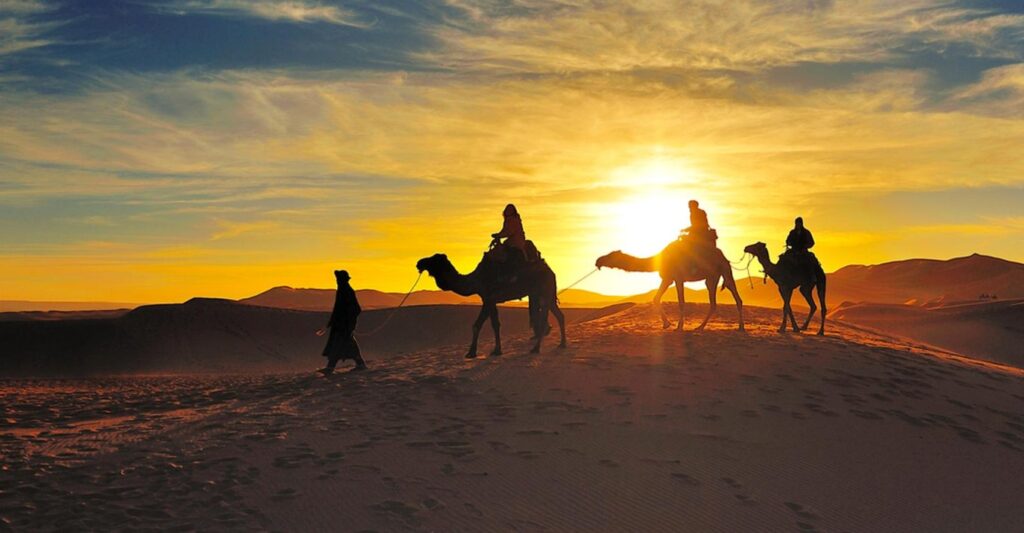
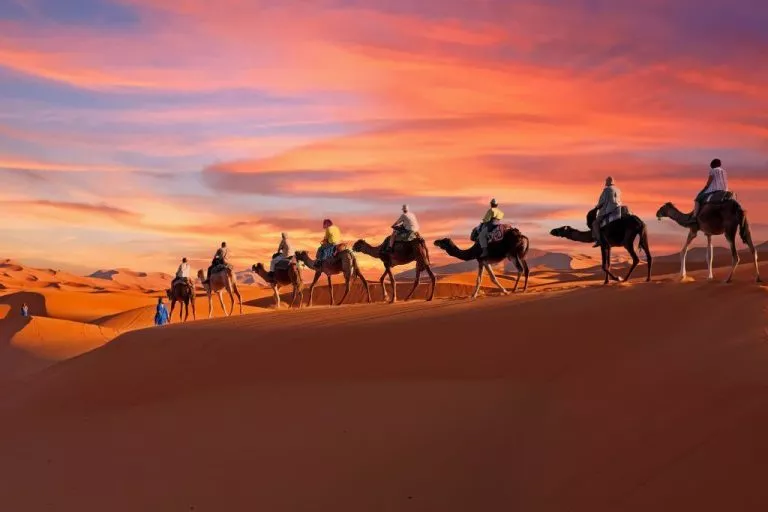
The classic Morocco desert experience — and at Erg Chigaga it is something beyond the classic version. The absence of other groups, the scale of the dunes, and the quality of the light at golden hour combine to make the Erg Chigaga sunset camel trek one of the more memorable hours available anywhere in North Africa.

The mounting process involves the camel lurching forward then back — hold on, everyone is surprised the first time — and after that the pace is slow and gentle and exactly right for watching the Sahara turn amber.

2. Sandboarding the 300-Metre Dunes

The dunes at Erg Chigaga are significantly taller than Erg Chebbi. Sandboarding down a 300-metre slope is a different proposition from 150 metres — faster, longer, more exhilarating, and deeply addictive. Most guests who try it spend the next two hours climbing back up and doing it again.

Best in the morning when the sand is cooler and firmer. Avoid midday sandboarding in summer — the sand surface temperature can exceed 70°C.

3. Stargazing and Astrophotography

Bortle Class 2 dark sky. The Milky Way visible to the naked eye. Zero light pollution in any direction. For astrophotographers this is a destination in its own right — not a bonus but the main event.

Moon phases matter significantly for photography: a new moon or thin crescent gives the darkest sky and the most dramatic shots. Check the lunar calendar before booking if astrophotography is a priority. A small travel tripod is worth bringing specifically for this.

4. Baking Sand Bread with Nomadic Guides

This one surprises people most. Desert bread — called khobz r’mmel or sand bread — is a traditional nomadic survival technique that has been used in the Sahara for generations. The dough is prepared and then buried in sand over an ember bed where it bakes slowly from below. What emerges, an hour later, is a dense round loaf with a characteristic smoky, earthy flavour that tastes nothing like bread from an oven and everything like where it was made.

Our guides who grew up in the desert learned this from their parents and grandparents. Sitting in the dunes and watching it being made — and then eating it fresh with argan oil — is one of those quiet experiences that guests describe for years afterwards. Nobody else in our experience runs this as a standard activity. We do.

5. Meeting Nomadic Families

The Saharan communities who move through the Erg Chigaga region are not a tourist attraction. They are families who have lived this way for generations, moving their herds through the desert according to water sources and pasture — a way of life that is genuinely ancient and increasingly rare.

On longer tours (2 nights minimum, ideally 3) our guides occasionally facilitate visits to nomadic family camps — with permission, with respect, and with the understanding that the encounter is on their terms not ours. These are not staged performances. They are genuine exchanges between travellers and people who live in the place the travellers have come to see. The memory they leave is different in character from anything else on the trip.


2026 Pricing — What It Actually Costs

Being direct about pricing saves everyone time:

Tour TypeDurationPrice range
Budget shared tour2 days / 1 night€120–€180 per person
Mid-range private3 days / 2 nights€280–€450 per person
Luxury private3-4 days€600+ per person
Extended expedition5-7 days€900+ per person

What affects the price:

  • Private vs shared (private adds 30-50%)
  • Standard vs luxury camp (luxury adds €50-150 per night)
  • Departure city (longer drive = higher cost)
  • Group size (larger groups reduce per-person cost)
  • Season (summer prices 20-30% lower — heat premium reversed)

Hidden costs to watch for: Some platforms advertise low base prices and add “shuttle fees” of €60-120 after booking. Always ask for the total all-in price before confirming. A reputable operator gives you a complete price upfront.


Responsible and Sustainable Travel at Erg Chigaga

The ecosystem of Erg Chigaga is fragile in ways that are not immediately obvious. The dunes look vast and permanent. They are not — they respond to how they are used. The Moroccan National Tourist Office actively promotes responsible desert tourism to protect these landscapes. Here is how to be a conscious traveller in one of Morocco’s most extraordinary natural spaces:

Choose Berber-led family camps. When you book with a locally-owned operator, the money stays in the community — with the guides, the camp staff, the families who have lived in this landscape for generations. We are one of these operators. We can tell you exactly where your money goes because we are the people it goes to.

Support solar-powered camps. Several camps at Erg Chigaga now run entirely on solar power with minimal generator use. The silence of the desert is partly natural and partly maintained — generators are one of the things that break it. Solar camps keep the environment intact and the experience authentic.

Leave no plastic. The desert has no waste collection. Every piece of plastic that comes in either leaves with you or stays forever. Our tours carry all waste out as standard. Pack a small bag for your own rubbish.

Ask before photographing people. The nomadic families and local guides who appear in the most striking desert photographs are people with their own relationship to being photographed. Ask first. Accept no gracefully. The photos you take with permission are better anyway.


Practical Information — What to Know Before You Go to Erg Chigaga

Fuel: Fill up in Zagora — last reliable fuel before the desert. M’Hamid has limited availability. Our vehicles carry extra fuel for the off-road section.

Cash: Moroccan dirhams only south of Ouarzazate. No ATMs function reliably in M’Hamid. The last reliable ATM is in Zagora. Withdraw enough for your full trip including tips (€10-15 per day per guide is appropriate), lunches (usually not included), and any extras.

Phone signal: Disappears in the Draa Valley south of Zagora. Does not return until heading back north. Download offline maps before losing signal. Tell someone your itinerary before departure.

Best time: October to April. March and October are the peak months — ideal temperatures, best light, most nomadic activity. Summer (June-August) temperatures regularly exceed 45°C and most camps reduce operations. Full seasonal guide →

How long to stay: One night minimum. Two nights significantly better. Three nights for the experience people actually remember for years. The second morning at Erg Chigaga — when you have woken up in the Sahara twice and the novelty has settled into something quieter — is when most guests understand why people come back.


Frequently Asked Questions

Can I drive to Erg Chigaga myself? No — not safely. The off-road section from M’Hamid requires a proper 4×4, local navigation knowledge, and desert driving experience. Two people die annually attempting this without a guide. Always go with a local operator who knows the route personally.

Is there WiFi at Erg Chigaga? No reliable WiFi. Some camps have satellite internet — slow and intermittent. Plan for a digital detox. Most guests find they stop minding within a few hours and are glad about it by day two.

Can unmarried couples share a tent? Yes, completely. Shared tents for couples are standard in Moroccan desert tourism regardless of marital status. This is not something that needs to be explained, hidden, or arranged differently. Book as a couple and it is treated as a couple.

Can I fly a drone at Erg Chigaga? Drone use in Morocco requires prior authorisation from the Moroccan civil aviation authority (ANAC). The process is bureaucratic and often denied for tourists. Attempting to fly without authorisation risks confiscation of the drone and fines. Some operators facilitate authorisation for professional photographers — ask specifically if this is important to you.

Is it safe to visit Erg Chigaga? Completely safe with proper organisation. The desert communities are welcoming and our guides are experienced and vetted. The risk that exists — getting lost or stuck in the off-road section — is entirely eliminated by going with a local guide who knows the route. We have operated tours here for over ten years without a serious incident.

What is the difference between M’Hamid and Foum Zguid approaches? M’Hamid is shorter (60km off-road, 2 hours) and the classic approach. Foum Zguid is longer (80-90km, 3-4 hours) and crosses Lake Iriki — a spectacular salt lake and former Paris-Dakar rally route that most tourists never see. If you have the time, Foum Zguid is the more extraordinary journey.

How does Erg Chigaga compare to Erg Chebbi for the journey? Erg Chebbi is reachable by paved road — no off-road required. Erg Chigaga requires the 4×4 off-road section. This is also why Erg Chigaga remains uncrowded. Full comparison →

What should I pack for the journey? Layers, closed shoes, sunscreen, a cheche/scarf, power bank, water, electrolytes, and cash in dirhams. Full packing guide →


Ready to Go?

Erg Chigaga is not the easiest desert to reach in Morocco. It is the best one. The journey — the long drive, the off-road crossing, the moment the dunes appear — is part of what makes arriving feel significant rather than just arriving.

We have been making this journey for over ten years. We know every section of every route. We know Lake Iriki in the rain and in the dry season. We know the guides who grew up in M’Hamid and whose families have navigated this desert for generations. We know what makes the difference between a good trip and one that people talk about for years.

Drop us a message. We will give you an honest recommendation based on your timeline, your group, and what you are actually looking for.

👉 Our Erg Chigaga tours from M’Hamid 👉 3-day Zagora to Erg Chigaga 👉 2-day Marrakech to Erg Chigaga 👉 Foum Zguid tours 👉 Contact us | 📞 +212 678-444071


About the author: This article was written by the guides at Zagora Desert Travel, a locally-owned Morocco desert tour operator based in Zagora since 2014. Rated 5 stars on TripAdvisor, Viator and GetYourGuide with over 500 verified reviews. Our team has guided travellers through both Erg Chigaga and Erg Chebbi for more than ten years.

Last updated: June 2026. Prices and logistics correct at time of writing — always verify current details with your operator before booking.

More from the blog: Erg Chigaga vs Erg Chebbi → · Morocco Desert Tour Experience → · Best Time to Visit Morocco Desert → · What to Pack for Morocco Desert Tour → · Complete Guide to Morocco Desert Tours →

What to Pack for Morocco Desert Tour

What to Pack for Morocco Desert Tour: Complete Checklist

What to Pack for Morocco Desert Tour — Stop Overthinking It

Every year we watch first-time visitors arrive with enormous suitcases full of things they never touch, and without the three or four items that would have made a genuine difference. After ten years of guiding people through the Moroccan Sahara in every season and every kind of weather, we have a pretty clear picture of what actually matters.

This is not a list generated by someone who did a Google search and added a few affiliate links. This is what we actually tell guests before they leave — the honest, practical version with the things that matter and the things you can confidently leave at home.

Quick Answer — What to pack for Morocco desert tour: You need layers (the desert gets shockingly cold at night), a scarf or cheche, high-SPF sunscreen, closed shoes, a power bank, and electrolytes. Everything else is optional. The full list is below, broken down by category and season so you can pack exactly what you need.


The One Item Nobody Mentions — But Everyone Needs

Before we get into the full Morocco desert packing list, let’s talk about the single most useful item you can bring — the one that comes up in almost every post-trip conversation we have with guests.

A lightweight scarf. Not a fashion scarf. A proper, large, breathable scarf — called a cheche in the Sahara — that wraps around your head and face.

Here is why it matters so much: the desert is not just hot and sunny. It is windy, sandy, cold at night, bright enough to cause headaches, and occasionally home to sandstorms that arrive with almost no warning. A good cheche handles all of these situations. It keeps the sun off your neck during the day, the sand out of your face when the wind picks up, and the cold out at night when you are sitting around the camp fire.

You can buy one in any market in Zagora or Merzouga for a few euros. Or bring one from home — a large, lightweight cotton or linen scarf in a light colour works perfectly. Either way, do not arrive in the desert without one.


Clothing — What Actually Works in the Desert

Daytime Clothes

The desert is hot during the day — sometimes very hot, depending on the season. But the approach of dressing in as little as possible is actually wrong for several reasons. Exposed skin burns faster, heats up faster, and gets damaged by blowing sand. Light coverage is better than no coverage.

What to bring:

Light, breathable long-sleeved shirts in pale colours are the ideal daytime desert garment. Linen or technical fabrics work well — anything that allows airflow while covering your arms. Bring two or three of these.

Lightweight trousers or shorts — your preference, but know that trousers protect your legs from sun and sand. On the camels especially, bare legs against the saddle is not comfortable.

A good hat or cap that actually stays on in wind. Baseball caps work. Wide-brimmed hats work better for sun protection but can be annoying in wind. Pick one you will actually wear.

What NOT to bring:

Heavy jeans — they are uncomfortable in heat, take forever to dry, and add serious weight to your bag. Leave them in your city hotel.

Anything white — the desert is sandy and dusty and white clothes become brown clothes very quickly.

High heels, platform sandals, or anything without a proper sole — the dunes are soft and uneven and you will regret it immediately.

Night Clothes — This is Where People Get It Wrong

This is the section most packing guides skip entirely and it is genuinely important.

The desert at night is cold. Not “a bit chilly” cold — properly, significantly cold, even in spring and autumn. In March, a day that reached 30°C can drop to 8-10°C after midnight. In December and January, temperatures can hit freezing and below.

Most first-time visitors massively underestimate this. They pack for the heat they expect and then spend the night in the desert huddled in every layer they brought, wishing they had packed more.

What to bring for desert nights:

A proper warm jacket — not a light zip-up hoodie but an actual jacket with insulation. Down jackets pack small and are ideal. Fleece works well too.

Thermal base layers if you are visiting between October and March — the kind you can pack flat and barely notice in your bag but that make a huge difference at 2am.

Warm socks. The desert ground at night is cold and even inside the camp tent your feet will feel it.

A hat and gloves for winter visits (December to February) — this sounds extreme but is genuinely necessary.


Sun and Sand Protection

Sunscreen

High SPF — 50+ — applied generously and reapplied regularly. The desert sun is intense in a way that catches people off guard. The combination of altitude, clear skies, and reflected light from the sand means you burn faster here than almost anywhere else.

Bring more than you think you need. A 200ml tube per person for a 3-day trip is not excessive.

Sunglasses

Proper sunglasses that seal reasonably close to your face, not fashion sunglasses that sit loosely on the bridge of your nose. The distinction matters when sand is blowing. UV protection is important — look for lenses that block 99-100% of UV rays.

Polarised lenses are helpful for reducing glare off the sand surface, which can cause significant headaches on bright days.

Lip Balm with SPF

Consistently forgotten, consistently regretted. The desert air is dry and the sun is intense and cracked lips after the first day are both painful and preventable. Pack it.


Footwear — Get This Right

The footwear question comes up constantly and the answer is simpler than most people make it.

Closed shoes are non-negotiable for dune walking. Sand gets into open-toed shoes within about three steps and it is deeply uncomfortable. It also heats up significantly and can burn the skin between your toes. Wear proper closed shoes or trail running shoes when walking in the dunes.

For the camels specifically — you need shoes that stay on your feet securely. The camel mounting and dismounting process involves some lurching and your feet will be dangling without much control. Slip-on sandals are a bad idea here.

Our actual recommendations:

Trail running shoes or light hiking shoes with a closed toe — good grip, comfortable for walking on uneven sand, breathe reasonably well.

Sandals are fine for around the camp in the evening — just not for dune walking or camel riding.

Flip flops for the camp bathroom/shower area — worth packing a lightweight pair specifically for this.


Tech and Gadgets

Power Bank — Non-Negotiable

Most desert camps have some form of electricity — usually solar-powered and therefore limited and unreliable. Assume you will not be able to charge your phone or camera from the camp. Bring a power bank that can charge your devices at least twice.

A capacity of 20,000mAh is sufficient for most people for a 2-3 night trip.

Camera

Your phone camera will produce excellent desert photos — the light is so good that almost everything looks beautiful. If you are bringing a dedicated camera, protect it from dust carefully. Fine desert sand finds its way into lens mechanisms faster than most people expect.

A dust-proof bag or sealed ziplock bag for storage when not in use. A UV filter on the lens if you have one. Lens cloths — pack several, you will use them.

Tripod

If you are remotely interested in astrophotography, pack a small travel tripod. The Milky Way over Erg Chigaga on a clear moonless night is one of the most photographed skies in Morocco. A lightweight travel tripod takes up minimal space and the photos it enables are genuinely extraordinary.

Headlamp or Torch

More useful than a phone torch — you need both hands free at night in the desert and a headlamp makes navigating between tents and the bathroom facilities infinitely easier. Pack a small one with fresh batteries.

Offline Maps

Download offline maps of your route before you leave areas with mobile data. Signal disappears somewhere in the Draa Valley and does not reliably return until you are heading back north. This applies to both navigation and general map use.


Health and Safety

Hydration — This is the Big One

The desert dehydrates you faster than almost any other environment because the air is so dry and the temperatures so extreme. The sensation of thirst lags behind actual dehydration — by the time you feel thirsty you are already significantly dehydrated.

Bring:

A reusable insulated water bottle — keeps water cool for longer and reduces plastic waste. A minimum of 2 litres capacity.

Electrolyte sachets or tablets — essential for replacing minerals lost through sweating in extreme heat, especially in summer or during any strenuous activity. Oral rehydration salts work well and are available cheaply.

Basic First Aid

A small personal first aid kit with your usual medications, pain relief, any prescription medication you take regularly (bring more than you need in case of delays), and blister plasters — dune walking creates friction on feet in ways that ordinary walking does not.

Anti-diarrhoea medication — worth having even if you do not expect to need it. Dietary changes and unfamiliar food occasionally cause issues and being in the desert without it is genuinely uncomfortable.

Motion Sickness

If you are prone to motion sickness, take medication before the mountain crossing from Marrakech — not halfway through when it is too late. The Atlas Mountain roads involve significant winding sections. Sit in the front seat. Most people find the issue resolves once the mountains are behind them and the road flattens.


Packing List by Season

Spring Packing List (March to May)

Spring is the most popular season for a reason — mild days, cool nights, and the best desert light. Here is exactly what you need:

Light breathable long-sleeved shirts × 2-3, lightweight trousers or shorts, a warm jacket for evenings (temperatures drop significantly after sunset even in April), thermal base layer if you run cold, closed walking shoes, sandals for camp evenings, high-SPF sunscreen, sunglasses, cheche/scarf, power bank, water bottle, electrolytes, headlamp, basic first aid kit.

Autumn Packing List (September to November)

Very similar to spring. October specifically can have warm days and cold nights — the temperature swing is dramatic.

Same as spring list plus: slightly warmer jacket (October nights can be genuinely cold), extra warm layer for camp evenings.

Winter Packing List (December to February)

Winter is underrated and beautiful but requires proper preparation for the cold.

Everything on the spring list plus: thermal base layers (essential, not optional), proper insulating jacket, gloves, warm hat, warm socks, sleeping bag liner if you run cold.

Summer Packing List (June to August)

Summer in the desert is extreme. If you are going — and we generally advise against it unless you are prepared — pack accordingly.

Everything on the spring list plus: loose long-sleeved shirts in the lightest fabrics you can find, extra sunscreen (reapply every 90 minutes minimum), electrolytes (bring double what you think you need), electrolyte-based sports drinks, cooling cloth, portable fan.


What NOT to Bring

This section exists because overpacking is genuinely as much of a problem as underpacking — and most packing guides only tell you what to bring.

Leave these at home:

Heavy denim jeans — uncomfortable in heat, heavy in your bag, take forever to dry.

Hair dryer or straighteners — no power in most desert camps and the desert air makes both pointless within minutes of stepping outside.

Valuable jewellery — dust, sand, and camel riding are not kind to delicate items.

Excessive toiletries — you will shower once at most during a 2-3 day desert trip. Pack travel sizes of the essentials.

High heels or dress shoes — no context in which these are useful in the desert.

More than two pairs of shoes — the space is not worth it.

Multiple bags — one manageable bag per person. The 4×4 journey to Erg Chigaga is bumpy and your bags will be in the back of the vehicle.


Packing for Different Trip Lengths

1-2 Night Morocco Desert Trip

Keep it minimal. A medium-sized daypack or small backpack is sufficient. You need: 2 outfit changes maximum, all the essentials from above, minimal toiletries. Resist the urge to bring a full suitcase for a 2-night stay.

3-5 Night Morocco Desert Trip

A medium-sized bag — not a large suitcase. Add one or two extra clothing changes, slightly more sunscreen, extra electrolytes. You still do not need as much as you think.

7+ Night Morocco Desert Trip

For longer trips you can bring more but the principle stays the same — focus on layers and sun protection, travel light on everything else. Consider that longer trips often involve more driving and a lighter bag means more comfort in the vehicle.


The Complete Morocco Desert Trip Checklist

Print this, tick it off, leave nothing behind:

Clothing:

  • Light long-sleeved shirts × 3
  • Lightweight trousers × 1-2
  • Warm jacket (insulating)
  • Thermal base layer (Oct-Mar)
  • Warm socks × 2 pairs
  • Underwear × 3-4
  • Gloves and warm hat (Dec-Feb)
  • Cheche/scarf (essential)
  • Closed walking shoes
  • Sandals for camp

Sun and sand protection:

  • High-SPF sunscreen (50+) × 1 large tube
  • Quality sunglasses
  • Wide-brimmed hat or cap
  • Lip balm with SPF

Tech:

  • Power bank (20,000mAh)
  • Phone charger cable
  • Camera + memory cards + lens cloths
  • Travel tripod (optional but recommended)
  • Headlamp + spare batteries
  • Offline maps downloaded

Health and hydration:

  • Insulated water bottle (2L+)
  • Electrolyte sachets × 6-10
  • Personal medications
  • Pain relief
  • Anti-diarrhoea medication
  • Blister plasters
  • Hand sanitiser
  • Motion sickness medication (if needed)

Documents and money:

  • Passport
  • Travel insurance documents
  • Emergency contacts written down
  • Cash in dirhams (cards not accepted in the desert)

Frequently Asked Questions

What to pack for Morocco desert tour if I am only going for one night? Minimal is the right approach. One change of clothes, a warm layer, sunscreen, sunglasses, a scarf, your phone and power bank, a water bottle, and basic toiletries. A daypack is sufficient.

What to wear in the Morocco desert as a woman? Light, breathable, covered. Long sleeves and trousers are practical for sun protection, camel riding comfort, and cultural respect in the villages along the route. A scarf is versatile and useful. Avoid white or very light colours that show dust immediately.

Can I buy things I forget in Morocco? Yes — Zagora and Merzouga both have small markets and shops. A cheche/scarf is actually better bought locally where the quality is good and the price is fair. Sunscreen is available but expensive and often not high enough SPF. Bring sunscreen from home.

Do I need a sleeping bag? Most camps provide blankets which are sufficient for spring, summer and autumn visits. For winter (December-February) a sleeping bag liner adds meaningful warmth. A full sleeping bag is rarely necessary unless you are camping independently.

What shoes are best for camel riding? Closed shoes with a secure fit that stay on your feet without active gripping. Trail runners or light hiking shoes. The camel mounting process involves lurching and you want shoes that stay put.

Is there anything specific to pack for Erg Chigaga vs Erg Chebbi? Erg Chigaga tends to be slightly hotter and windier than Erg Chebbi due to its location. Pack the cheche particularly carefully for Erg Chigaga — the wind can be stronger there. The off-road journey to Erg Chigaga is bumpy, so pack bags that close securely. Read our full comparison →

What is the best time of year to visit and does it change what I need to pack? Significantly yes — winter requires proper thermal layers while summer requires extreme heat preparation. Full seasonal packing guide here →


Ready to Pack and Go?

The Morocco desert packing list does not need to be complicated. Layers for the temperature swing, sun protection, a good scarf, closed shoes, and a power bank. Everything else is secondary.

If you are still not sure what to bring for your specific trip — the season, the duration, the destination — drop us a message. We are based in Zagora and have been answering this question for ten years. We will give you a specific recommendation for your exact situation in about two minutes.

👉 Browse our Morocco desert tours 👉 3-day Zagora to Erg Chigaga tour 👉 3-day Marrakech desert tour 👉 Contact us | 📞 +212 678-444071


About the author: This article was written by the guides at Zagora Desert Travel, a locally-owned Morocco desert tour operator based in Zagora since 2014. Rated 5 stars on TripAdvisor, Viator and GetYourGuide with over 500 verified reviews. Our team has guided travellers through both Erg Chigaga and Erg Chebbi for more than ten years.

Last updated: June 2026. Prices and logistics correct at time of writing — always verify current details with your operator before booking.

More from the blog: Morocco Desert Tour Experience → · Best Time to Visit Morocco Desert → · Erg Chigaga vs Erg Chebbi → · How to Get to Erg Chigaga → · Complete Guide to Morocco Desert Tours →

morocco desert tour experience

Morocco Desert Tour Experience — Honest Advice from 20 Years of Guiding

Is the Morocco Desert Tour Experience Actually Worth the 10-Hour Drive?

Okay, let’s just get this out of the way right now — yes, it is. Completely and totally worth it. But here’s the thing nobody tells you upfront: the Morocco desert tour experience is not quite what those dreamy Instagram reels make it look like. And that’s actually a good thing, because the reality is better in ways that are harder to photograph.

The drive from Marrakech to Erg Chigaga? That’s 560 kilometres and somewhere between 8 and 10 hours in a car. Merzouga clocks in at around 9 hours. I know, I know — that sounds like a lot. And if you get in the car expecting to arrive quickly, you’re going to have a bad time. But if you go in knowing the drive is part of the experience? You’ll be staring out the window the whole way with your jaw slightly open, wondering why nobody mentioned the Atlas Mountains looked like this.

We’ve been taking people into the Moroccan Sahara for over ten years. In that time we’ve watched hundreds of first-timers step off a camel on their second morning, look out at the dunes, and just… go quiet for a bit. In a good way. Every single time. The morocco desert tour experience does that to people.

Worth it? Yeah. We’ve never seen anyone leave unchanged.


Quick Summary — Morocco Desert Tour Experience 2026:

Here’s the short version if you’re in a hurry: plan for at least 2-3 nights, get private transport if you can swing it, expect a sunset camel ride on arrival and a sunrise that’ll mess you up emotionally. Best months: October to April. Most remote option: Erg Chigaga. Best for first-timers: Erg Chebbi near Merzouga. Budget: €200-550 per person for a private tour. Red flag to avoid: 1-night rush tours and any booking platform hiding shuttle fees in the small print.


Which Desert Should You Actually Go To?

Morocco’s got four main desert options and they’re genuinely quite different from each other. The morocco desert tour experience you get at each one is completely different — here’s the honest rundown with no sugar-coating:

Merzouga (Erg Chebbi) — The One You’ve Seen on Instagram

You know those photos. Giant orange dunes, dramatic sunset light, camels silhouetted against the sky. That’s Erg Chebbi. And honestly? It really does look like that. The orange colour comes from iron oxide in the sand — basically the same stuff that makes rust red — and the dunes hit about 150 metres tall. First impression is genuinely jaw-dropping.

Here’s the catch though: everybody knows about it. During peak season you’re sharing those dunes with quite a few other people. You can see other camps from your camp. The popular sunrise peaks have a queue. It’s a bit like visiting the Eiffel Tower — absolutely stunning, completely worth it, but don’t expect to have it to yourself.

For first-timers who want a gorgeous, well-organised, no-stress desert experience? Erg Chebbi is perfect. For people chasing solitude? Keep reading.

Good for: First-timers, families, people who specifically want that classic orange dune shot. Drive time: 9-10 hours from Marrakech. Fully paved, no drama. How long to stay: 2 nights minimum — one night really isn’t enough.


Zagora — The Sneaky Good Option

Zagora is only 6-7 hours from Marrakech, which in Morocco desert terms is practically next door. The landscape around the town is beautiful — the Draa Valley has these incredible palm groves and ancient kasbahs that feel genuinely timeless — but the dunes near Zagora are smaller than Erg Chebbi or Erg Chigaga.

The reason Zagora matters is what’s beyond it. It’s the last proper town before Erg Chigaga, which makes it the perfect jumping-off point for the most remote desert experience in Morocco. If you’re based here, you’re already at the Sahara’s front door — the big dunes are reachable the same afternoon.

Good for: Travellers without much time, or as a base for Erg Chigaga trips. Drive time: 6-7 hours from Marrakech. How long to stay: 1-2 nights.


Agafay — The Lazy (But Totally Valid) Option

Right, so Agafay isn’t technically a sand desert. It’s a rocky hammada plateau about 30-45 minutes outside Marrakech. No towering dunes here — just dramatic pale rock, dry riverbeds, and views of the Atlas Mountains in the distance.

But here’s why people love it: some seriously luxurious camps have set up out there with infinity pools, proper restaurants, and glamping setups that feel like they should be in a design magazine. If you want a desert-adjacent evening — sunset cocktails, stargazing from a comfortable camp bed — without spending three days in a car, Agafay delivers.

Just be honest with yourself about what it is. It’s not the Sahara. It’s a beautiful rocky landscape with excellent sundowner potential. If you’ve got the time, go further south. If you’ve got one evening? Agafay is genuinely lovely.

Good for: Day trips, luxury glamping, anyone with 48 hours or less. Drive time: 30-45 minutes from Marrakech. How long to stay: Half a day to one night.


M’Hamid and Erg Chigaga — The Real Deal

Okay, now we’re talking. This is our home turf and we’re not even slightly embarrassed about being biased here, because the facts back us up.

M’Hamid El Ghizlane is where the paved road stops. Literally ends. After that it’s 60 kilometres of off-road desert track to Erg Chigaga — the biggest, most remote desert in Morocco. The dunes stretch 40 kilometres and reach 300 metres in places. Local Berber guides call the biggest one “The Father Dune.” You’ll get it immediately when you see it.

Because getting here takes effort, it filters the visitors. The camps are spread across a huge area, which means real privacy — on most nights you won’t see another camp from yours. The sky is Bortle Class 2, which is basically as dark as it gets on this planet. The Milky Way doesn’t just appear — it dominates the sky in a way that makes you feel the planet rotating under you if you stare at it long enough.

You do need a 4×4 and a guide who knows the route. The track shifts after wind. Don’t try this independently — people get seriously disoriented out there without local knowledge.

Good for: Repeat visitors, stargazers, couples wanting privacy, anyone who’s done Erg Chebbi and wants to go deeper. Drive time: 8-10 hours to M’Hamid, then 2 hours off-road to the dunes. How long to stay: 2 nights minimum. 3 is better. 4 is if you never want to leave.

👉 Full Erg Chigaga vs Erg Chebbi comparison here →


Shared Tour vs Private Tour vs Going It Alone — Let’s Be Real

How you get to the desert shapes the morocco desert tour experience significantly — more than most people realise before they book.

Shared Tours — The Budget Option (With Caveats)

Shared tours run about €150-250 per person and you’ll be in a minibus with other travellers. For solo travellers who want to meet people this can actually be great — the shared experience creates a certain camaraderie that private tours don’t always have.

The honest downsides though: you move at the group’s pace, which isn’t always your pace. There are often stops at commission-based shops — carpet sellers, argan oil cooperatives — where the guide gets a cut and you get a 40-minute detour you didn’t ask for. The vehicles are usually large minibuses that handle hairpin mountain roads with all the grace of a shopping trolley.

Fine if budget is the priority. Go in knowing what you’re signing up for.

Private Tours — Worth It More Often Than You’d Think

Private tours cost €200-550+ per person depending on how long you go and where you stay. For couples the per-person cost is often only slightly more than shared — you’re splitting a vehicle and a guide between two people rather than twelve.

What you get: your own pace, your own stops, zero carpet shops unless you specifically want one, and a proper 4×4 for the off-road sections. For families especially, the flexibility is genuinely worth the premium.

The Flight Option Nobody Talks About

Here’s a fun fact that most travel blogs completely ignore: there are direct flights between Marrakech and Zagora. Takes about 45 minutes. Bypasses the entire mountain crossing.

Now look — the drive through the Atlas Mountains is spectacular and we recommend doing it at least once. But if the 10-hour car journey genuinely isn’t feasible for health reasons, or you’re travelling with very young children, or you simply cannot afford the time — flying is a legitimate option. It just gets less attention because it’s less romantic to write about.


The Real 3-Day Itinerary — What Actually Happens

Day 1 — The Mountain Crossing

Leave Marrakech around 7-8am. The city disappears faster than you’d expect and within an hour you’re climbing into the High Atlas via the Tizi n’Tichka pass at 2,260 metres. In winter there can be snow up here. In spring it’s green and dramatic. Always, it’s the kind of road that makes you want to stop every twenty minutes to take a photo — which you will do, don’t fight it.

Mid-morning brings Ait Benhaddou — a UNESCO kasbah that’s been in Gladiator, Game of Thrones, and Lawrence of Arabia. It looks almost too cinematic to be real. Worth at least an hour. Avoid the 11am-2pm tourist crush if you can.

After Ouarzazate the landscape does this thing where it just… opens. The mountains fall away, the terrain goes flat and stony, and the Draa Valley palm groves appear like someone dropped a green ribbon across the desert. Most people aren’t expecting how beautiful this part is.

Arrive at camp in late afternoon — ideally 4-5pm — for that golden hour light on the dunes. This timing is not accidental.

Day 2 — The Desert Day (The One That Gets You)

No driving. Just desert. This is the day that defines the morocco desert tour experience for most people.

Set an alarm for before sunrise — around 5:30am. You won’t want to. Do it anyway. The desert at that hour is pink and gold and impossibly quiet and every single person who does it is glad they did. Without exception.

The morning camel trek or dune walk happens in this light. After breakfast, the day becomes unstructured — and here’s something interesting: most guests who are used to busy itineraries find this unexpected free time genuinely difficult for about twenty minutes, and then profoundly good. There’s nowhere to go. Nothing to do. Just the desert, and you in it.

Afternoon rest. This is the Berber approach to the hottest part of the day and it turns out to be extremely correct. Late afternoon the light shifts, the photography window opens, and the dunes go golden again.

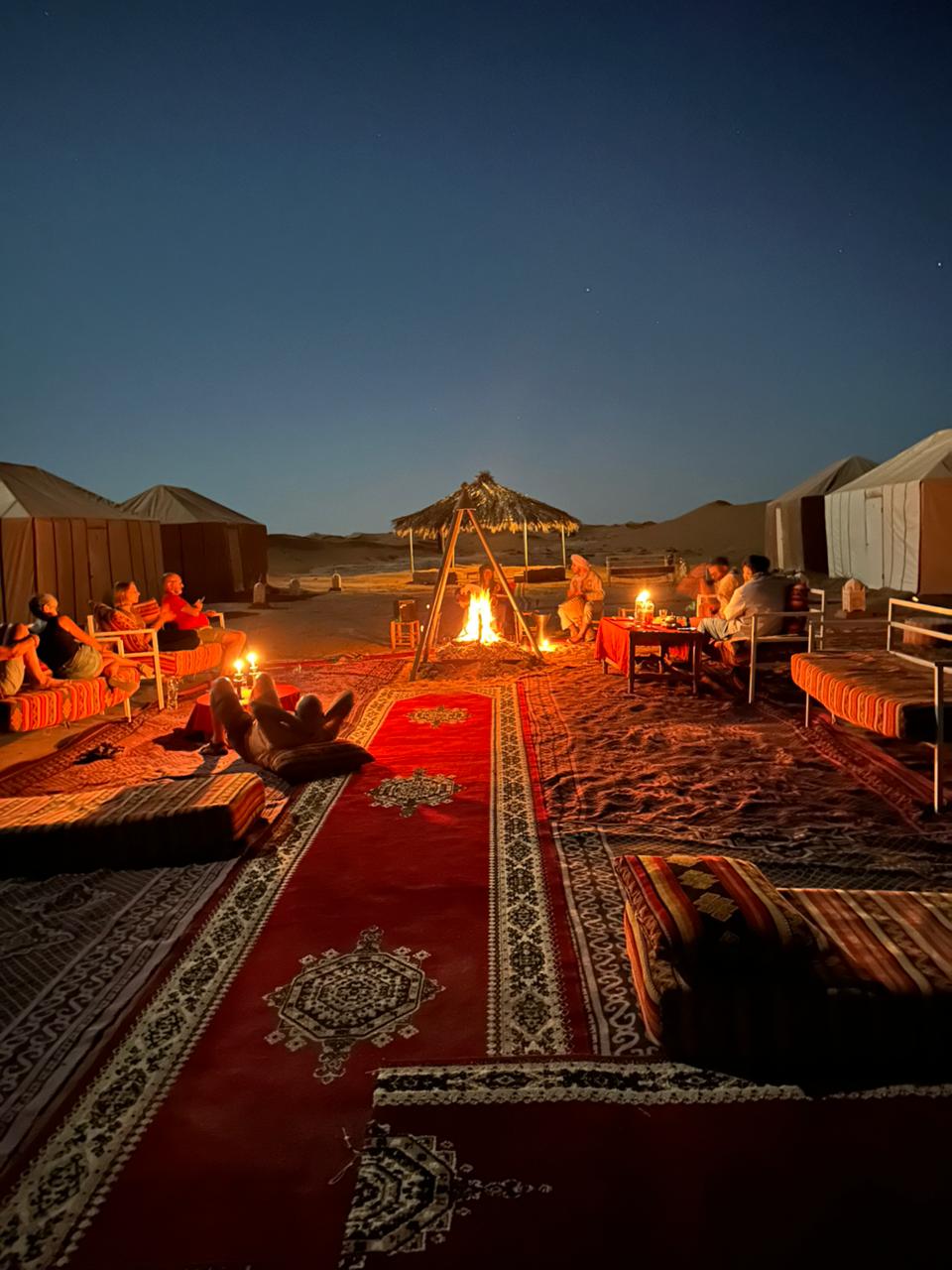
Dinner. Fire if it’s cold. Music if the mood takes it. Stars from about 10pm onwards. The second night in the desert is when most people say something clicked — when the novelty wore off and what was left was just the place itself. This is the night people remember.

Day 3 — The Long Way Home

The return is long. There’s no getting around this. The road doesn’t get shorter just because you’ve had a transformative experience in the desert. Snacks, music, and realistic expectations — you’ll be back in Marrakech by evening.

Some guests do the route one-way — entering from Marrakech and exiting toward Fez, or vice versa. This avoids retracing the same road and adds variety. Slightly more complicated to arrange but worth considering for longer itineraries.


What “Luxury Desert Camp” Actually Means (Because It Varies a Lot)

Right, this is important because the word “luxury” in desert camp marketing covers everything from “slightly nicer than basic” to “genuinely excellent.” The accommodation you choose shapes your entire morocco desert tour experience more than any other single factor.

Here’s what actual luxury looks like: a real bed with a proper mattress and good quality linen (not a floor mattress on a rug), a private en-suite bathroom with a hot shower and an actual porcelain toilet, some electricity for phone charging (solar-dependent so not always 24/7), and food that’s properly cooked rather than thrown together.

Here’s the warning: some camps advertised as luxury on major booking platforms are managed by third parties who tack on “shuttle fees” of €60-120 per person after booking. These aren’t included in the room price and only appear in the fine print. Always ask for the total cost including all transfers before you confirm anything.

Our camps are ones we’ve used and continue to inspect personally. We don’t recommend anywhere we haven’t been ourselves.


10 Things I Genuinely Wish Someone Had Told Me

After ten years of guiding first-timers through the morocco desert tour experience, here are the things guests most consistently wish they’d known beforehand:

1. Camel riding is more uncomfortable than it looks. The mounting process involves the camel lurching forward and then back in a way that nobody is prepared for the first time. Hold on. Once moving it’s gentle enough, but after an hour most people have sore inner thighs. This is normal. Keep rides reasonable in length.

2. It gets cold. Like, properly cold. Even in April. Even after a 30°C afternoon. The desert temperature can drop 15-20 degrees after sunset. People who packed only summer clothes are always the ones quietly asking if there are any spare blankets. Pack a proper warm layer, every single time.

3. The mountain roads will test you if you’re prone to motion sickness. Countless hairpin turns through the Atlas. If this is you, take medication before departure — not halfway through when it’s too late. Sit in the front seat. Most people find it resolves once the mountains are behind you.

4. Budget about €100 extra for things not included. Lunch is almost never in the tour price. Add in tips for guides and camp staff (€10-15 per day per guide is appropriate), water for the journey, and any spontaneous extras. The €100 covers this comfortably for most people.

5. WiFi in the deep desert is basically a myth. Some camps have satellite internet. It’s slow, it drops constantly, and some days it doesn’t work at all. Plan to be offline. Most guests are initially mildly annoyed by this and then extremely glad about it by day two.

6. Vegans need to be specific and persistent. Moroccan cuisine defaults to meat in ways that aren’t always obvious from the description. “Vegetable” dishes can contain chicken broth. Some samosas that look vegetarian have meat inside. Tell your operator clearly before the tour and remind the camp again on arrival. Good operators handle this without difficulty — just give them the heads up.

7. The drive is the experience. Don’t sleep through it. The landscapes between Marrakech and the Sahara — the Atlas Mountains, the Draa Valley, the ancient kasbahs — are extraordinary. Stare out the window the whole way. You’re not in transit. You’re already on the trip.

8. One night is never enough. We say this every time and people still book one night sometimes. Almost every single person who does it wishes they’d booked two. The second night is when the desert stops being a tourist experience and starts being something else. Two nights minimum. Please.

9. Your guide knows things that aren’t in any guidebook. The guides who lead these tours grew up in the desert. They know the stars by name in Berber, Arabic, and French. They know which plants survive on almost no water and why. They know the stories of the families who still move through this landscape. Have the conversations. They’re some of the best parts of the trip.

10. Put the phone down sometimes. The desert is one of the few places left where being fully present is genuinely easy. The photos will be good either way. The experience of being there without a screen between you and it is better.


Solo Female Travel — The Honest Version

The morocco desert tour experience is safe for solo female travellers and the desert communities are welcoming. But honest advice beats empty reassurance, so here’s what we’d actually tell a friend:

Don’t book with anyone who approaches you on the street. Djemaa el-Fna touts, people outside your riad — skip them. Reputable operators have verifiable online reviews and clear contact details. That accountability matters.

Filter reviews by traveller type. Most platforms let you see reviews specifically from solo women. That’s the relevant data for your situation — use it.

Some unwanted attention happens and it’s worth acknowledging. It’s not universal and depends heavily on which operator you go with. Setting firm, early, friendly-but-clear boundaries is effective in most situations. Staying with other travellers in the evenings and not being the last one awake with guides you don’t know well are practical rather than paranoid precautions. Trust your instincts.

All our guides are vetted, work with us season after season, and we’ve removed people from the team for this reason before. If anything feels off during a tour — contact us directly, any time.


What to Pack — The Actually Useful List

Packing right makes a real difference to your morocco desert tour experience — especially around temperature management which catches almost everyone off guard.

Whatever season, bring these:

A lightweight scarf or cheche — sun protection, sand shield, cold layer, face covering. It does everything and takes up no space. High-SPF sunscreen applied generously and frequently. Good sunglasses that actually seal around your eyes rather than sitting loosely on your face. A reusable insulated water bottle. Closed shoes for dune walking — not sandals, your feet will thank you.

Winter additions (December to February):

Thermal base layers that pack small. A proper warm jacket — not a fleece hoodie, an actual jacket. Gloves. A sleeping bag liner if you run cold. The desert at 2°C is not messing around and the layers genuinely matter.

Summer additions (June to August):

Electrolyte sachets — non-negotiable in extreme heat. Loose, light-coloured long sleeves that breathe. A small portable fan for the midday rest. More water than you think you’ll need.

Tech:

Portable power bank — assume limited electricity at camp. A tripod if you’re serious about astrophotography — the sky genuinely justifies it. Camera with proper dust protection — fine desert sand gets into lens mechanisms faster than you’d believe. Offline maps downloaded before you lose signal in the Draa Valley.


Frequently Asked Questions

Here are the questions we get asked most often about the morocco desert tour experience:

Can I visit the Sahara in a day trip from Marrakech? Technically yes. Practically — it’s 9-10 hours of driving each way for maybe 2 hours at the destination. You’d spend 18 hours in a car to see the desert for about the length of a long lunch. Don’t do this. One overnight stay minimum. Two is significantly better.

Is a Morocco desert tour safe? Yes. Morocco is genuinely welcoming to tourists and the desert regions particularly so. Book with a verified operator, tell someone your itinerary, use your normal good judgement. You’ll be completely fine.

Merzouga or Zagora — which should I pick? Merzouga (Erg Chebbi) for the classic orange dunes and better infrastructure. Zagora as a base for Erg Chigaga tours or if you’re short on time. For the most remote and spectacular experience — M’Hamid and Erg Chigaga, no contest. Full comparison here →

What’s the best time of year to go? March to May and September to November. March and October are the sweet spot months. Full month-by-month guide here →

How much does it actually cost? Shared tours: €150-250 per person. Private tours: €200-550+ depending on length and accommodation level. Luxury camps add roughly €50-150 per night. Budget €100 extra for lunches, tips, and things not in the tour price.

What does “luxury camp” actually mean? A real bed with good linen, private en-suite bathroom with a hot shower and actual toilet, some electricity, decent food. Watch out for hidden shuttle fees (€60-120) on booking platforms — ask for the total all-in price before confirming.

Is camel trekking suitable for everyone? Most people yes. The mounting process is alarming the first time and extended rides leave you with sore thighs — keep it to 45 minutes to 2 hours. People with significant back or mobility issues should check with their operator first.

How long should I actually stay? One night if you genuinely have no choice. Two nights if you want to actually feel the place. Three or more if you want the experience that people struggle to describe afterwards. Our most popular first-timer option — 3 days from Zagora →


Ready to Go?

Look — the morocco desert tour experience is one of those things that’s genuinely hard to oversell because the reality keeps up with the hype. The drive is long. The cold at night catches everyone off guard. And the second morning in the desert does something to people that takes a while to explain when they get home.

We’re a small local team based in Zagora. We’ve been doing this for over ten years and we still find it remarkable. Message us and we’ll give you an honest recommendation based on your actual situation — budget, timing, travel style — not a sales pitch designed to get you to book the most expensive option.

👉 Browse all Morocco desert tours 👉 Most popular first-timer tour — 3 days Zagora to Erg Chigaga 👉 2-day Marrakech to Erg Chigaga 👉 Get in touch | 📞 +212 678-444071


About the author: This article was written by the guides at Zagora Desert Travel, a locally-owned Morocco desert tour operator based in Zagora since 2014. Rated 5 stars on TripAdvisor, Viator and GetYourGuide with over 500 verified reviews. Our team has guided travellers through both Erg Chigaga and Erg Chebbi for more than ten years.

Last updated: June 2026. Prices and logistics correct at time of writing — always verify current details with your operator before booking.


More from the blog: Erg Chigaga vs Erg Chebbi → · Best Time to Visit Morocco Desert → · Morocco Desert Packing List → · How to Get to Erg Chigaga → · Complete Guide to Morocco Desert Tours →

Best time to visit Morocco desert

Best Time to Visit Morocco Desert — The Complete Seasonal Guide 2026

Introduction — The Sahara Waits for You, But Timing Matters

There is a moment that happens to almost every visitor to the Moroccan Sahara. It usually comes on the first evening — standing on a dune as the light turns golden, the silence so complete you can hear your own heartbeat, the sky starting to show its first stars before it has even finished being blue. People who experience it tend to go quiet for a while. Then they usually say some version of the same thing: “I should have come here sooner.”

The good news is that the Moroccan Sahara is a year-round destination. The less good news is that not every month gives you that moment with equal ease. The best time to visit Morocco desert depends on what you are after — the golden light of spring, the crisp stargazing skies of winter, the solitude of an off-season visit, or the challenge of the summer heat.

We have been guiding people through the Moroccan desert for over ten years. We have been here in every season, at every hour. Here is the honest answer.


The Quick Answer — Best Time to Visit Morocco Desert:

The best time to visit the Morocco desert is October to April. Peak months are March–April and October–November when daytime temperatures sit between 20–30°C — warm enough for camel trekking and dune walking, cool enough to be genuinely comfortable. Avoid June to August unless you are specifically prepared for extreme heat — temperatures regularly exceed 45°C and heatstroke is a real risk.


Quick Reference — Morocco Desert Weather by Season

SeasonMonthsDay TempNight TempCrowdsOur Rating
SpringMar–May25–32°C12–18°CMedium⭐⭐⭐⭐⭐ Best
AutumnSep–Nov22–30°C10–15°CLow–Medium⭐⭐⭐⭐⭐ Best
WinterDec–Feb18–22°C0–5°CLow⭐⭐⭐⭐ Great
SummerJun–Aug42–48°C24–26°CVery low⭐⭐ Challenging

The Seasonal Breakdown — What Each Time of Year Actually Feels Like

Spring (March to May) — The Prime Season

Spring is the best time to visit Morocco desert — and the numbers back that up. Daytime temperatures sit between 25 and 32°C, warm enough to feel like proper desert but comfortable enough to spend hours outside without suffering. Nights cool to between 12 and 18°C, which means sleeping in the desert camp is actually pleasant rather than an endurance test.

The landscape in spring has a particular quality. After winter rains the desert can surprise you — patches of wildflowers appearing between the dunes, the air feeling cleaner than you expect, and that extraordinary clarity of light that makes every photograph look like it was taken by someone who actually knows what they are doing.

Spring is the best time to visit Morocco desert for camel trekking specifically. The temperatures are ideal for both the camels and the riders, and the golden hour light that comes in the late afternoon — sideways across the dunes, casting long deep shadows — is what most of the iconic Morocco desert photographs are actually taken in.

Cultural festivals happen in spring too. The Sahara Festival in Merzouga and various local moussem events bring Berber music, horse fantasia, and traditional crafts to the desert communities. If this interests you, check dates before booking — they vary year to year.

One thing worth knowing: the Sirocco wind can arrive in spring, carrying fine sand from deeper in the Sahara and reducing visibility. It is not dangerous, but it can be intense for an hour or two. Our guides know how to read the conditions and will adjust itineraries accordingly.

Best spring tours:


Autumn (September to November) — The Photographer’s Choice

Autumn is equally good for the best time to visit Morocco desert — some of our guides say it is actually better, for reasons that are hard to explain until you experience them.

The temperatures are similar to spring. Daytime sits between 22 and 30°C, nights between 10 and 15°C. Comfortable, clear, and calm. But the light in autumn has a different character. The sun sits lower earlier in the day, which means the golden hour photography window is longer — sometimes stretching for two or three hours in the late afternoon rather than the tight window you get in summer. The shadows on the dunes are longer and more dramatic. Photographers who have been to both spring and autumn often prefer autumn for exactly this reason.

Autumn is also the season when nomadic families are most visible in the deep desert. The brutal summer heat has passed and families who spend the hottest months closer to villages begin moving their herds back through the erg. On longer Erg Chigaga tours in October and November, encounters with nomadic families are more likely than at any other time of year — and with a good guide who knows the community, these moments can become the most memorable part of the trip.

Tourist numbers are lower in autumn than spring — particularly in October, which is one of the quietest months of the year while still offering near-perfect conditions. If you want the desert more to yourself, October is your month.

Best autumn tours:


Winter (December to February) — Crisp Skies and Cold Nights

Winter in the Moroccan desert is something most visitors do not expect to be beautiful. It is. Genuinely, surprisingly beautiful. And for certain travellers — particularly stargazers and photographers — winter is actually their preferred best time to visit Morocco desert.

Daytime temperatures sit between 18 and 22°C — pleasantly warm in the sunshine, comfortable for walking and exploring. The cold arrives after sunset. Desert nights in December and January can drop to 0–5°C, and occasionally below freezing in exposed locations. This is not the romanticised version of cold. It is actual cold. You need proper layers, a warm sleeping setup, and ideally a camp that has thought about heating.

The reward for accepting the cold is the sky. Winter nights in the Moroccan Sahara offer some of the best stargazing conditions on earth. The air is driest in winter, the clarity exceptional, and with tourist numbers at their lowest the darkness around the camps is more complete. Bortle Class 2 conditions — essentially the darkest sky rating available — mean the Milky Way is not just visible but overwhelming. We have had guests spend three hours lying on their backs after dinner, completely silent, just watching.

The daytime landscape in winter has its own drama. Occasional rains between November and February can transform the desert briefly — a thin green fuzz appearing on rocky hammada, the occasional pool of water in a dry riverbed, the dunes looking slightly darker and denser than in summer. It does not last. But catching it is special.

Tourist crowds are minimal in December and January — with the exception of the Christmas and New Year period when the desert fills up quickly and camps book out weeks in advance. If you are visiting in late December, book early.

Best winter tours:


Summer (June to August) — Is It Worth the Heat?

We are going to be honest with you here, the way we would be honest with a friend.

Summer in the Moroccan Sahara is extreme. Temperatures regularly reach 45°C during the day and have been recorded above 50°C. The ground radiates heat. The air does not move. Standing in the sun between 10am and 5pm is genuinely uncomfortable and can be dangerous — heatstroke and dehydration are real risks, not theoretical ones.

Most experienced desert operators — including us — advise against visiting in July and August unless you have a specific reason to come in summer and know what you are signing up for.

That said, there is a contrarian case for summer that deserves to be made honestly.

Summer is cheap. Significantly cheaper than peak season — some camps reduce rates by 40-50%. It is quiet. The desert in July is about as close to empty as it gets. And the nights — this part surprises people — the summer nights are actually warm and comfortable, sitting around 24-25°C. If you organise your day entirely around the cool hours (pre-dawn and evening), sleeping during the hottest midday hours as the Berber tradition dictates, summer can offer a different kind of desert experience. The golden hour photography is extraordinary. The silence is profound.

But it requires genuine heat tolerance, proper preparation, and experienced guides who know how to manage the conditions. It is not something we recommend for families with children, older travellers, or anyone without prior experience of extreme heat environments.


Regional Variations — Which Desert at Which Time?

The Morocco desert is not one place. Here is how timing affects each main destination differently — because the best time to visit Morocco desert can vary slightly depending on which part of the desert you are heading to:

Erg Chebbi (Merzouga)

The most accessible desert in Morocco, Erg Chebbi sits near Merzouga in eastern Morocco. Its proximity to the Atlas Mountains means it benefits slightly from mountain air circulation — daytime temperatures are typically 2-3°C cooler than Erg Chigaga in summer, and the Sirocco winds that arrive in spring tend to dissipate slightly before reaching the dunes. Good for all seasons. At its best in spring and autumn.

Erg Chigaga

Remote, larger, and hotter. Erg Chigaga sits in the deep south, in an area that receives less moderating influence from mountains or coast. Summer temperatures here are more extreme than Merzouga — this is where the 50°C readings happen. In spring and autumn it is glorious. In winter the remoteness means the stargazing is the best in Morocco. Avoid in July and August unless you know exactly what you are doing.

Agafay Desert

The Agafay is not technically a sand desert — it is a rocky hammada plateau, around 30-45 minutes from Marrakech. The landscape is dramatic but different in character from the great ergs. Visit Morocco lists it as one of the country’s most accessible desert experiences. It is excellent for spring and autumn day trips from Marrakech, and for sunset dinners and glamping experiences that do not require a long drive south. In summer the heat is less extreme than the deeper desert, making it a reasonable option for visitors who want a desert experience without the full commitment of reaching Erg Chigaga or Erg Chebbi.


Best Time by Activity

Knowing the best time to visit Morocco desert is one thing — but the ideal timing can also depend on what you specifically want to do while you are there:

Camel Trekking

October to April. The camels are comfortable, the riders are comfortable, and the light is right. Avoid midday riding in any season — early morning or late afternoon is always the better experience regardless of time of year.

Stargazing

Winter gives you the clearest skies — the driest air, the lowest light pollution from other camps, and the longest nights. But any moonless night from October through April will give you a sky that most people have never seen before. Summer nights are warm enough to lie outside comfortably for hours, which has its own appeal if you can handle the heat during the day.

Sandboarding

Best when the sand surface is cool and firm — early morning in any season, or throughout the day in winter. In summer the sand surface temperature can exceed 70°C and sandboarding becomes genuinely dangerous to skin and equipment.

4×4 Expeditions

Autumn (October-November) is ideal for long 4×4 expeditions into the deep desert. The temperatures are manageable, the ground conditions are good after the summer, and the nomadic communities are moving through the desert which adds an extra layer of experience to longer routes.

Photography

Autumn for the longest golden hours and most dramatic shadows. Spring for the blooms and festival atmosphere. Winter for the star trails and frost-cleared air. Summer for the heat haze abstract landscapes that require a specific eye but produce extraordinary images.


Best Time by Departure City

The best time to visit Morocco desert also depends on where you are starting your journey from. Here is how timing affects each departure city:

From Marrakech

Spring is magical — crossing the High Atlas when the mountains are still partly snow-capped and descending into a desert that is warm but not brutal. Autumn is equally spectacular. The drive through the Dades Gorge in October light is one of the more beautiful journeys in Morocco.

👉 3-day Marrakech desert tour — perfect for spring and autumn visits

From Zagora

Zagora sits at the edge of the Sahara and is warm year-round. The town itself becomes very hot in summer but the desert tours from Zagora can be adapted for any season — early morning starts in summer, full-day itineraries in spring and autumn.

👉 Overnight Zagora desert experience — ideal year-round with flexible morning start times

From Fez

The road from Fez to the desert crosses the Middle Atlas — which means in winter you are driving through cedar forests that may have snow. It is stunning but adds time and requires care on mountain roads. Spring and autumn are the ideal seasons for this route.

👉 3-day Zagora to Erg Chigaga tour — combine Fez with the deep desert in spring or autumn

From Casablanca

The long Casablanca itineraries work well in spring and autumn when the variety of landscapes — coast, mountains, valley, desert — are all at their seasonal best simultaneously. In winter the contrast between the grey Atlantic coast and the golden desert is dramatic in its own way.

👉 5-day Morocco itinerary — the perfect length to experience coast, mountains and desert in one trip


Essential Planning — What the Tour Operators Won’t Always Tell You

Once you have decided the best time to visit Morocco desert for your situation, here is the practical information most travel sites do not cover honestly:

How to Book

Book directly with a locally-based operator rather than through a generic aggregator platform if possible. Large booking platforms bundle desert tours with standardised itineraries that often rush the experience — one night in the desert is not enough to really feel it, and many platform tours are designed around what is logistically convenient rather than what is experientially meaningful.

Two to three nights in the desert is the minimum for real immersion. One night gives you a sunset and a sunrise. Two nights gives you that and the silence of a full desert night, the stars without the adrenaline of arrival, and the slower rhythm of Berber desert life starting to feel familiar.

We are genuinely not saying this just to sell longer tours. One-night guests almost universally wish they had stayed longer. It is one of the most consistent pieces of feedback we receive.

Getting There

Three realistic options depending on your priorities:

Private transfer — most comfortable, most flexible, most expensive. Your guide picks you up, you stop where you want, you arrive when it makes sense. The right choice for families, older travellers, and anyone for whom the journey quality matters.

Supratours bus — the budget option. Regular services from Marrakech to Ouarzazate and onward. Cheap, reasonably reliable, but long and inflexible. Good for solo travellers on a tight budget who do not mind the time.

Rental car — freedom and flexibility. Works well for confident drivers familiar with Moroccan road conditions. Not recommended for the off-road sections to Erg Chigaga — you need a specialist 4×4 for that section regardless of what you drive to M’Hamid.

Duration

Two to three days minimum. Here is the honest breakdown of what you actually experience at each duration:

1 night — you arrive, see the sunset, sleep in the desert, see the sunrise, leave. Beautiful but brief.

2 nights — you have time to breathe. The second night in the desert is when most people say it clicked. The novelty has passed and what remains is genuine presence.

3 nights and beyond — for Erg Chigaga especially, three nights allows for real exploration of the dune system, encounters with nomadic families, and the kind of experience people spend years trying to describe to friends who were not there.


Packing Checklist by Season

Universal — Bring These Any Time of Year

A good quality scarf or cheche is the single most useful item in the desert — it protects from sun, sand, wind, and cold depending on how you wear it. High-SPF sunscreen (50+) applied generously and often. Proper sunglasses that seal around the eyes rather than just sitting on the bridge of the nose. A reusable insulated water bottle — hydration in the desert is not optional. Comfortable closed walking shoes for dune walking.

Winter Additions

Thermal base layers that you can pack small but that make a genuine difference at 2°C. A warm fleece or down jacket for evenings and early mornings. Gloves — genuinely necessary in December and January, not just a comfort item. A sleeping bag liner if you want extra warmth in the camp tent.

Summer Additions

Electrolyte sachets — essential for replacing what you lose in the extreme heat. Loose, light-coloured long-sleeved shirts that protect skin from the sun while allowing airflow. A personal cooling cloth or small portable fan for the midday rest period. Extra water capacity beyond what you think you will need.


Frequently Asked Questions

When is the best time to visit Morocco desert for families? Spring and autumn are ideal for families — temperatures are comfortable for children, camel trekking is manageable, and the days are long enough to explore without rushing. Avoid summer with young children due to extreme heat.

Does it rain in the Sahara desert Morocco? Yes, but rarely. Annual rainfall in the Moroccan Sahara averages between 25 and 100mm depending on location — for context, London gets around 600mm per year. According to the Morocco Meteorological Directorate, most rain falls between November and February. When it does rain, the desert transforms briefly and dramatically — worth seeing if you catch it.

How cold does it get at night in the Morocco desert? Winter nights in the desert regularly drop to 0–5°C and occasionally below freezing. Summer nights stay warm at around 24–25°C. Spring and autumn nights range from 10–18°C — cool enough to sleep well, warm enough to sit outside comfortably.

Can I visit the Morocco desert during Ramadan? Yes. The desert experience itself is largely unaffected. Guides and camp staff observe the fast, which means schedules may adjust slightly — later starts to the day, larger meals after sunset. Some restaurants in towns along the route may be closed during daylight hours. We recommend being respectful of the fast and planning meals accordingly. In some ways Ramadan adds a dimension to the cultural experience that is worth being present for.

Is the Morocco desert safe for solo female travellers? Yes — Morocco and the desert regions are generally safe for solo female travellers. The desert communities are welcoming and guides are professional. The standard advice applies: book with a reputable operator, share your itinerary with someone at home, and use your normal judgement. Many of our solo guests are women and the consistent feedback is positive.

What is the difference between Erg Chigaga and Erg Chebbi in terms of weather? Erg Chigaga tends to be 2–3°C hotter than Erg Chebbi in summer due to its greater distance from the Atlas Mountains and the coast. In spring, autumn and winter the difference is minimal. Erg Chigaga is generally windier — the open terrain means less shelter from the Sirocco. Both offer exceptional conditions during the October–April window. Read our full comparison →

How far in advance should I book? For spring (March–May) and the Christmas/New Year period: at least 4–6 weeks ahead, ideally more. For autumn and winter: 2–3 weeks is usually sufficient outside of school holiday periods. For summer: last-minute booking is usually possible given lower demand.


The Final Verdict — When Should You Go?

If you can choose freely, March and October are the two best individual months — the absolute best time to visit Morocco desert in our experience. March combines ideal temperatures, spring light, and the energy of post-winter opening. October combines perfect photography conditions, nomadic activity in the deep desert, and enough quiet that you can have significant sections of Erg Chigaga more or less to yourself.

If you cannot choose freely, do not let the month stop you. The Sahara is extraordinary in all seasons. Winter gives you the stars. Summer gives you the challenge and the quiet. The desert does not have a bad time to visit — only better and less-better times, and even the less-better ones tend to produce the kind of memories that stay with people for years.

We have watched people arrive at the desert in every month and we have never once seen someone leave unchanged.


Still not sure when your trip works best? Drop us a message and we will help you find the right timing for your specific situation — no obligation, just honest advice from people who are here year-round.

👉 Browse our Morocco desert tours 👉 Contact us | 📞 +212 678-444071


About the author: This article was written by the guides at Zagora Desert Travel, a locally-owned Morocco desert tour operator based in Zagora since 2014. Rated 5 stars on TripAdvisor, Viator and GetYourGuide with over 500 verified reviews. Our team has guided travellers through both Erg Chigaga and Erg Chebbi for more than ten years.

Last updated: June 2026. Prices and logistics correct at time of writing — always verify current details with your operator before booking.

More from the blog: Erg Chigaga vs Erg Chebbi — Which Desert Should You Visit in 2026? → · What to Expect on a Morocco Desert Tour → · Morocco Desert Packing List → · How to Get to Erg Chigaga → · Complete Guide to Morocco Desert Tours →
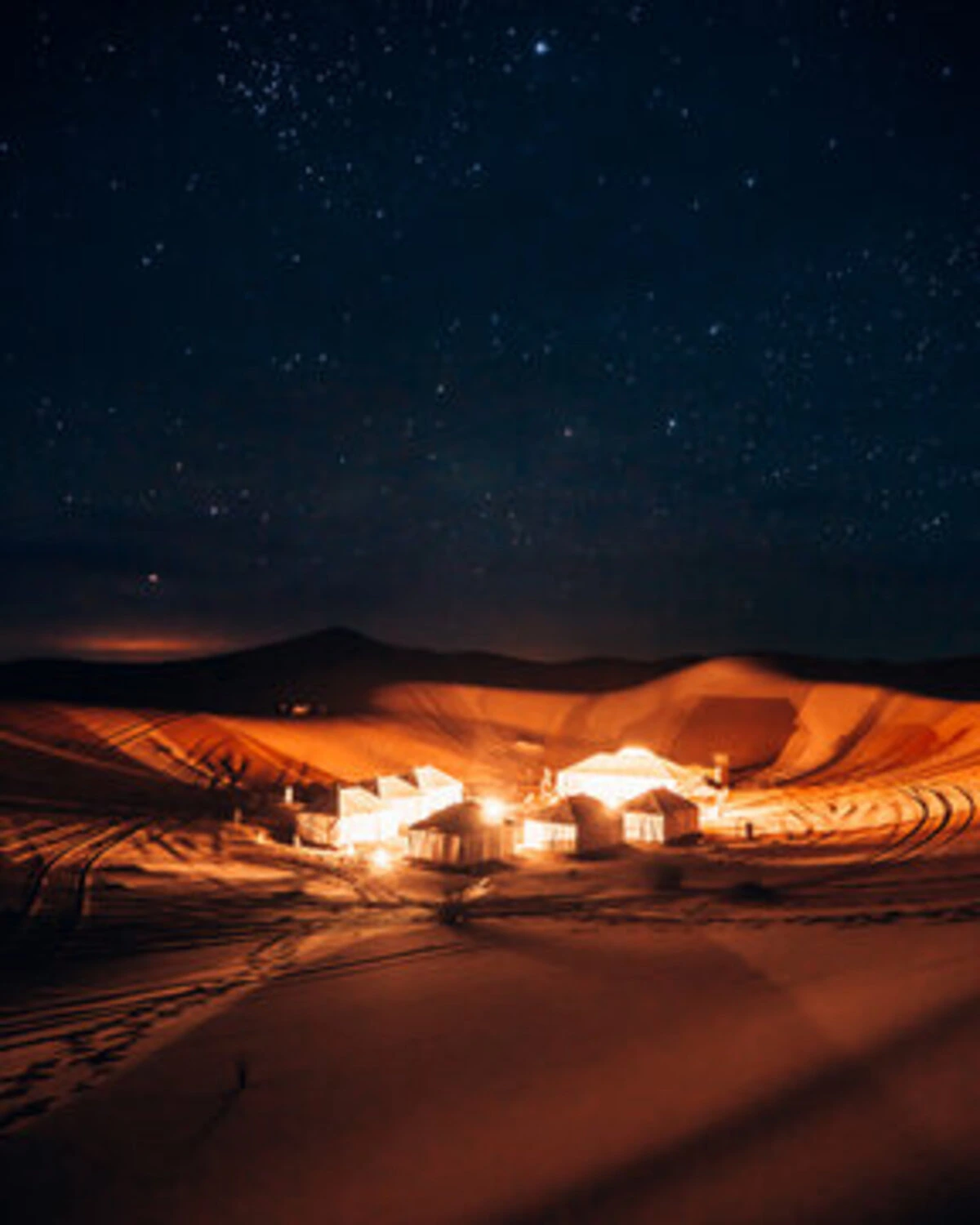
Erg Chigaga vs Erg Chebbi

Erg Chigaga vs Erg Chebbi: How to Choose in 2026

The Tale of Two Saharas

Every year thousands of travellers arrive in Morocco with the same dilemma — Erg Chigaga or Erg Chebbi? Two deserts, two completely different experiences, and usually just one trip to choose between them.

We have been guiding people through both for over ten years. And the question we get asked more than any other — more than “is it safe”, more than “what should I pack” — is this one.

Whether you searched “erg chigaga vs erg chebbi” or “erg chebbi vs erg chigaga” — same question, same answer. Both are part of Morocco’s extraordinary sahara desert experience, and both deserve to be understood on their own terms. So here is what we actually think, after a decade of watching people experience both.

The 50-word honest summary: Erg Chebbi near Merzouga is the accessible, iconic Sahara — 150m orange dunes reachable by any car, luxury camps from $30 to $900, ideal for first-timers and families. Erg Chigaga near M’Hamid is the remote, wild Sahara — 40km of dunes up to 300m, requiring a 4×4, offering silence and Bortle Class 2 dark skies.

Before we go further, a quick note on terminology. An erg is a sand sea — a vast expanse of wind-shaped dunes. A hammada is stony desert, the flat rocky plateau you cross to reach the ergs. Both Erg Chebbi and Erg Chigaga rise dramatically out of hammada, which is part of what makes arriving at either of them feel so cinematic.


Quick Comparison — Erg Chebbi vs Erg Chigaga at a Glance

FeatureErg Chebbi (Merzouga)Erg Chigaga (M’Hamid)
Tallest dune~150 metres90m to 300m (varied)
AccessPaved road all the way60km off-road 4×4 required
Drive from Marrakech9–10 hours11–12 hours
VibePopular, well-organised, convenientWild, remote, deeply silent
Best forFirst-timers, families, photographersAdventurers, repeat visitors, stargazers
CrowdsSignificant in peak seasonMinimal year-round
Price range$30 budget to $900 luxuryMid to high — 4×4 adds cost
StargazingGoodExceptional (Bortle Class 2)
Wi-Fi at campSome luxury camps have itGenerally disconnected
Unique featuresGnawa music, mineral museumsLake Iriqi, nomadic families

Erg Chebbi — The Iconic Dunes of Merzouga

There is a reason Erg Chebbi appears on more screensavers, more travel magazine covers, and more Instagram grids than any other desert in Morocco.

The dunes are orange. Not brownish, not yellowish — genuinely, properly, vividly orange in a way that makes photographers slightly unhinged at golden hour. The colour comes from iron oxide in the sand — the same mineral that makes rust red — which gives Erg Chebbi its signature appearance and makes it visually unlike any other desert we know. They rise like a sand wall directly out of the flat stony hammada, climbing steeply to around 150 metres at the highest point. The visual impact when you first see them is immediate and a little disorienting — you are driving through nothing interesting and then suddenly there they are, these enormous amber walls appearing out of nowhere.

The colour shifts through the day. Pale gold in the morning, deepening to copper by midday, and then burning orange and deep red as the sun drops. If you time a camel ride right — late afternoon, heading towards the high dunes with the light coming in sideways — it looks almost fictional. Like someone turned the saturation up.

Getting there is genuinely easy. Paved roads from Marrakech, Fes, and all major Moroccan cities. Standard rental car. Even buses run to Merzouga. No special preparation, no specialist vehicle, no local guide required to actually reach the dunes. Walk out of your accommodation and you are on the sand in minutes.

The infrastructure at Erg Chebbi is the most developed of any desert camp area in Morocco. Budget travellers can find a basic tent with shared facilities for around $30 a night. At the other end of the market, ultra-luxury setups with private pools, air conditioning, restaurant service, and genuine hotel-quality beds run to $900 or more per night. The range in between is wide and the competition between operators keeps quality reasonably honest across all price points.

The flip side of all this convenience is that you share it. Erg Chebbi receives a significant volume of tourists during peak season — October through April — and on popular dune peaks at sunrise you will be sharing the moment with others. The glow from Merzouga village and the lights of the camps create some ambient light that affects stargazing conditions near the dune edge. The village itself can feel busy and occasionally pushy with operators approaching new arrivals.

Things that make Erg Chebbi worth visiting beyond the dunes themselves: the village of Khamlia, about ten kilometres away, where the Gnawa community performs traditional music in an informal, genuinely moving setting. The mineral and fossil museums in nearby Erfoud, which are more interesting than they sound. Sandboarding on the high dunes, which gets addictive faster than most activities in Morocco. And the simple pleasure of watching the Sahara desert Morocco light show at the end of a long day — that particular colour the sky goes over the dunes just after sunset, when everything turns purple and the first stars appear.

Ready to experience Erg Chebbi? Our 3-day Marrakech to Merzouga tour is one of our most popular routes — crossing the High Atlas, stopping at Ait Benhaddou, and arriving at the orange dunes in time for sunset on day two.


Erg Chigaga — The Remote Wilderness

Getting to Erg Chigaga is part of the experience. Not in a marketing-speak way — actually, genuinely part of it.

From M’Hamid El Ghizlane, the last town with a paved road at the end of the Draa Valley, the route to the dunes covers roughly 60 kilometres of off-road desert track. A proper 4×4, a knowledgeable local guide, and around two hours of bumpy, exhilarating travel across what the guides here call the moonscape — flat hammada that looks identical in every direction, with the occasional rocky outcrop and the track shifting underfoot depending on how recently the wind has been through. There are no signs. There is no GPS signal in parts of it. People without local knowledge do get disoriented here. This is not hypothetical — two travellers die annually attempting this route unguided.

Arriving at Erg Chigaga after that journey has a specific quality that Erg Chebbi — for all its drama — cannot fully replicate. You have earned the view.

The vast golden dunes of Erg Chigaga — stretching 40km with peaks reaching 300 metres

The dunes themselves are different in character. Erg Chigaga covers a larger surface area than Erg Chebbi — stretching roughly 35 to 40 kilometres in length — and while some peaks reach 300 metres, the landscape is more varied and sculptural, with what geographers call star dunes: multi-armed formations that look different from every angle and create a chaotic, dramatic topography that photographers with a more adventurous eye tend to prefer. The colour is golden rather than orange, shifting through amber and copper as the light moves.

The silence at Erg Chigaga is the thing people talk about most when they come back. Because the camps are spread across such a vast area, you can spend two full days without seeing another group. No ambient noise from other tourists. No distant generator hum from the next camp. The desert at 3am out there is something that is genuinely difficult to describe and that stays with people for a long time afterwards.

One story that stays with us. Last October we took a couple from London to Erg Chigaga for their honeymoon. They had visited Erg Chebbi two years earlier and wanted something deeper. On the second night our guide woke them at 2am to look at the sky. They stood outside the tent for forty minutes without speaking. She told us afterwards she had never felt so small in the best possible way. That is the difference between the two deserts in one story.

Our luxury Berber camp at Erg Chigaga — traditional style, genuine comfort, complete silence

Want to experience Erg Chigaga for yourself? We offer several ways to get there — a 2-day Zagora desert tour for those short on time, a 3-day Zagora to Erg Chigaga desert tour for a proper immersive experience, or a 3-day camels dunes and nomadic tents tour if you want the full Berber experience. Coming from Marrakech? Our 2-day Marrakech to Erg Chigaga tour gets you there directly.

The stargazing is exceptional. Erg Chigaga sits at Bortle Class 2 on the light pollution scale — one of the darkest sky ratings available on earth. The Milky Way is not just visible but overwhelming on a clear moonless night, the kind of sky that makes you feel the planet actually moving under you if you stare at it long enough. We have watched grown adults step outside the tent on their first night and go completely silent. Every time, without exception.

Two things about Erg Chigaga that most travel articles miss:

Lake Iriqi is a seasonal salt lake on the edge of the erg that, in years with enough rainfall, reflects the dunes and the sky in a way that looks completely implausible. It appears and disappears depending on rainfall and the timing is never guaranteed, which is part of what makes seeing it feel like luck in the best sense.

The nomadic families who still move through this part of the desert are occasionally encountered on longer tours — Berber families who have been navigating this landscape for generations. With a guide who knows the area well, a brief visit to a nomadic camp is occasionally possible and is an experience with a weight to it that is hard to get anywhere else in Morocco.

The practical considerations: Erg Chigaga costs more than Erg Chebbi at comparable quality levels because the 4×4 transport and specialist guiding are non-negotiable parts of the experience. The off-road journey is bumpy enough that it is worth considering for very young children or anyone prone to motion sickness. And the camps, while we are proud of them, are fewer in number — so booking ahead matters more here than at Erg Chebbi.


Which One Is Right for You?

Rather than a simple verdict, here is an honest breakdown by situation.

If you have 3 to 4 days: Go to Erg Chebbi. The logistics of reaching Erg Chigaga and doing it properly require more time, and a rushed Erg Chigaga experience misses the point of going there. Our 3-day Marrakech desert tour is the perfect introduction to the Moroccan Sahara.

If you have 5 to 7 days: Erg Chigaga becomes the right choice, or the hybrid route (more on that below). Our 5-day Morocco itinerary gives you enough time to sit in the silence, do a proper overnight camel trek, and experience the stargazing without feeling like you need to rush back.

Photographers: Erg Chebbi for the iconic orange colour and dramatic height, especially if you want recognisable Morocco desert experience shots. Erg Chigaga for clean, uncluttered compositions — no other tents in frame, no tourist footprints on your dune face, and the star dune formations that look unlike anything else in Morocco.

Families with young children: Erg Chebbi. Easier access, wider range of accommodation that suits families, shorter camel rides, and the infrastructure to handle logistics that are harder with small children in very remote locations.

Couples and honeymooners: Erg Chigaga, without question. The privacy is not just available — it is the default. Dinner for two in a luxury tent with nothing visible in any direction except the dunes and the Milky Way overhead is a difficult experience to improve on. Our 3-day Zagora to Erg Chigaga tour is particularly popular with couples.

morocco desert tours
4 days tour from marrakech to fes

Repeat visitors who have already seen Erg Chebbi: Erg Chigaga. Go deeper. You will understand immediately why. Start with our tours from M’Hamid for the most direct access to the dunes.


The Pro Move — How to Visit Both

If you have seven days and a tolerance for long drives, the hybrid itinerary is one of the most satisfying routes in Morocco. It is not for everyone — the driving is significant — but it gives you a direct comparison of two very different desert characters that makes both more vivid, not less.

The route runs roughly like this: Marrakech → Dades Valley (overnight, worth it for the gorges) → Erg Chebbi near Merzouga (two nights minimum) → Tagounite (transit day, the Draa Valley is genuinely beautiful) → Erg Chigaga near M’Hamid (two nights minimum) → Foum Zguid → back to Marrakech.

The contrast when you arrive at Erg Chigaga after Erg Chebbi is striking. The silence lands differently when you have just come from somewhere busier. The scale of the dunes registers differently. And the stargazing on your first night at Erg Chigaga, after the relative light pollution of Merzouga, makes a particular impression.

Most guests who do this route tell us it was one of the better travel decisions they made. The combination of the iconic and the remote, experienced back to back, is more than the sum of its parts.


Logistics and Timing — What You Actually Need to Know

When to go: October through April is the sweet spot for both deserts. Temperatures are manageable — warm days, cold nights, and that particular quality of desert light that makes everything look like a painting. July and August regularly hit 48°C in both locations. It is not just uncomfortable — it is genuinely dangerous for anyone not acclimatised. We steer people firmly away from midsummer.

What to pack: This matters more than most travellers expect. The desert temperature swings between daytime heat and cold nights that catch people off guard even in April. Layers are essential — a warm fleece or jacket for after sunset even in what feels like warm weather. Wind protection for the eyes matters more during sandstorms than most people anticipate; a lightweight scarf or shemagh that covers the face is more useful than sunglasses alone. Camera gear needs dust protection — fine sand gets into everything. Bring more than you think you need and seal everything in bags when not in use.

Booking: Book your camp in advance, particularly for Erg Chigaga where options are fewer. Avoid booking on arrival in M’Hamid or Merzouga — the operators who approach new arrivals in town are not always the ones running the best or most ethical camps. A reputable operator confirmed before you travel is worth the effort. Ask specifically about camel welfare if this matters to you — ethical treatment varies between operators and it is worth asking the question directly. The Moroccan National Tourist Office also provides official guidance on responsible desert tourism if you want an independent reference.


Questions People Ask Us

Which is bigger — Erg Chebbi or Erg Chigaga? Erg Chigaga is larger in surface area, stretching roughly 35 to 40 kilometres. Erg Chebbi is taller at its highest point — around 150 metres compared to Erg Chigaga’s more varied profile of 90 to 300 metres depending on location.

Can I drive myself to Erg Chigaga? No — and this is not a formality. The route from M’Hamid requires a real 4×4, sand-driving experience, GPS knowledge, and genuine familiarity with desert navigation. The track shifts after wind. There are no markers. Two people die annually attempting this without a local guide (source: Moroccan civil protection authority desert incident records). Book with a reputable operator and go with someone who knows the route personally.

Is there Wi-Fi in the desert? At Erg Chebbi, some luxury camps have satellite Wi-Fi. At Erg Chigaga, you are generally disconnected — which most guests, once they arrive, stop minding surprisingly quickly.

What is the difference between erg and hammada? An erg is a sand sea — the dunes. A hammada is stony desert, the flat rocky terrain you cross to reach the ergs. Both Erg Chebbi and Erg Chigaga rise out of hammada, which is part of what makes arriving at them feel so dramatic.

Is Erg Chigaga safe? Completely safe with proper organisation — a local guide and a reliable 4×4. Not safe without them. With a reputable operator, it is a well-managed experience. We have been running these tours for over ten years without incident. Browse our guided Erg Chigaga tours here.

Which has better stargazing? Erg Chigaga, clearly. Its Bortle Class 2 dark sky rating puts it among the best stargazing locations on earth. Erg Chebbi offers good stargazing by most standards but has some ambient light from Merzouga village that Erg Chigaga simply does not have.

Best time of year for either desert? October to April for both. March and April are particularly good — warm, clear, and the desert after occasional winter rains can have a particular quality of light that is hard to describe. Full month-by-month guide here →


Still not sure which one is right for you? That is exactly what we are here for. Drop us a message and we will give you an honest answer based on what you are actually looking for — not a sales pitch, just a real recommendation from people who know both deserts well.

👉 All Morocco desert tours 👉 Contact us | 📞 +212 678-444071


About the author: This article was written by the guides at Zagora Desert Travel, a locally-owned Morocco desert tour operator based in Zagora since 2014. Rated 5 stars on TripAdvisor, Viator and GetYourGuide with over 500 verified reviews. Our team has guided travellers through both Erg Chigaga and Erg Chebbi for more than ten years.

Last updated: June 2026. Prices and logistics correct at time of writing — always verify current details with your operator before booking.

More from the blog: Complete Guide to Morocco Desert Tours 2026 → · How to Get to Erg Chigaga → · Morocco Desert Packing List → · What to Expect on a Morocco Desert Tour → · Best Time to Visit Morocco Desert →