
Introduction — The Sahara Waits for You, But Timing Matters
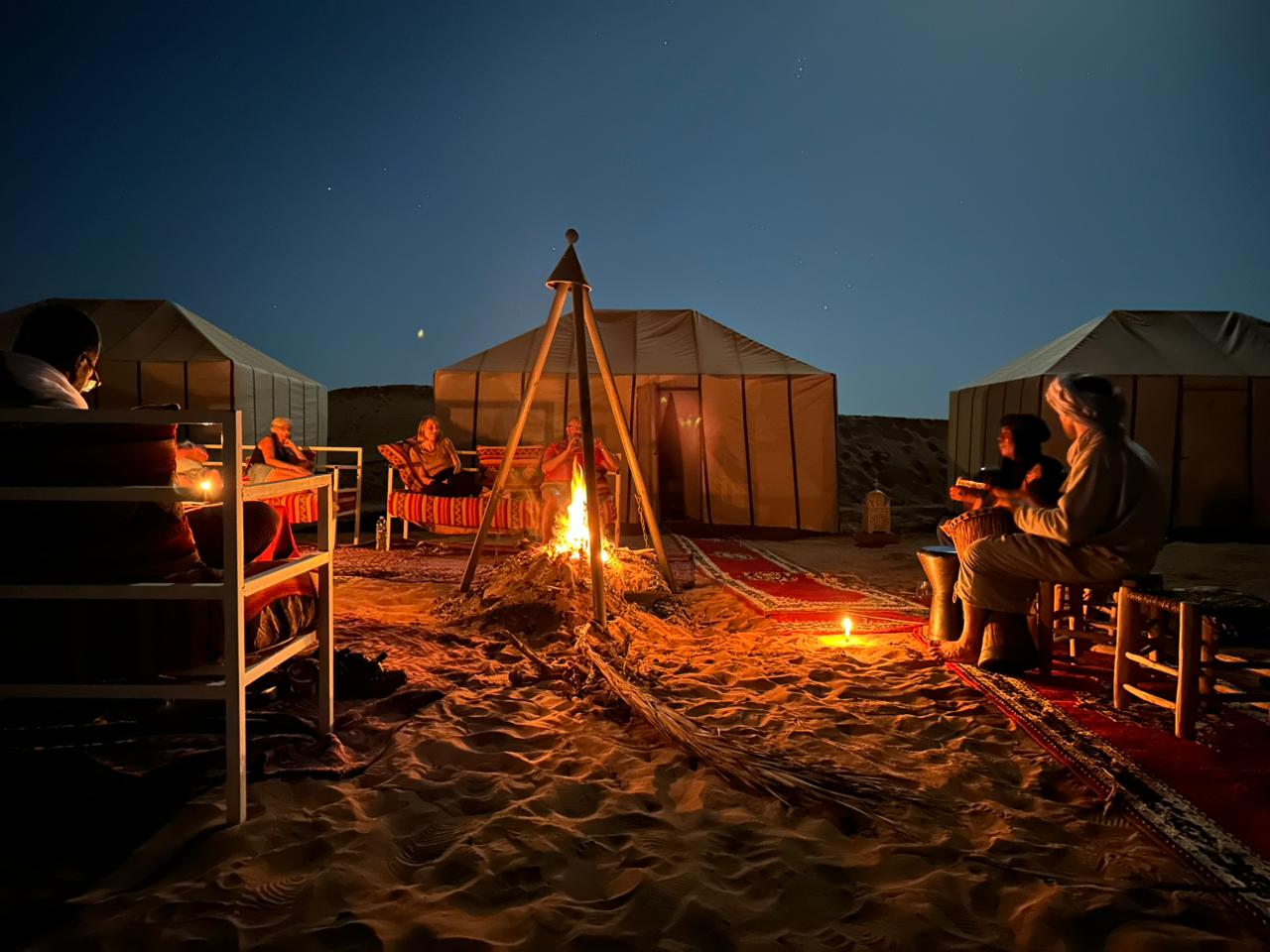
There is a moment that happens to almost every visitor to the Moroccan Sahara. It usually comes on the first evening — standing on a dune as the light turns golden, the silence so complete you can hear your own heartbeat, the sky starting to show its first stars before it has even finished being blue. People who experience it tend to go quiet for a while. Then they usually say some version of the same thing: “I should have come here sooner.”
The good news is that the Moroccan Sahara is a year-round destination. The less good news is that not every month gives you that moment with equal ease. The best time to visit Morocco desert depends on what you are after — the golden light of spring, the crisp stargazing skies of winter, the solitude of an off-season visit, or the challenge of the summer heat.
We have been guiding people through the Moroccan desert for over ten years. We have been here in every season, at every hour. Here is the honest answer.
The Quick Answer — Best Time to Visit Morocco Desert:
The best time to visit the Morocco desert is October to April. Peak months are March–April and October–November when daytime temperatures sit between 20–30°C — warm enough for camel trekking and dune walking, cool enough to be genuinely comfortable. Avoid June to August unless you are specifically prepared for extreme heat — temperatures regularly exceed 45°C and heatstroke is a real risk.
Table of Contents
Quick Reference — Morocco Desert Weather by Season
| Season | Months | Day Temp | Night Temp | Crowds | Our Rating |
|---|---|---|---|---|---|
| Spring | Mar–May | 25–32°C | 12–18°C | Medium | ⭐⭐⭐⭐⭐ Best |
| Autumn | Sep–Nov | 22–30°C | 10–15°C | Low–Medium | ⭐⭐⭐⭐⭐ Best |
| Winter | Dec–Feb | 18–22°C | 0–5°C | Low | ⭐⭐⭐⭐ Great |
| Summer | Jun–Aug | 42–48°C | 24–26°C | Very low | ⭐⭐ Challenging |
The Seasonal Breakdown — What Each Time of Year Actually Feels Like
Spring (March to May) — The Prime Season
Spring is the best time to visit Morocco desert — and the numbers back that up. Daytime temperatures sit between 25 and 32°C, warm enough to feel like proper desert but comfortable enough to spend hours outside without suffering. Nights cool to between 12 and 18°C, which means sleeping in the desert camp is actually pleasant rather than an endurance test.
The landscape in spring has a particular quality. After winter rains the desert can surprise you — patches of wildflowers appearing between the dunes, the air feeling cleaner than you expect, and that extraordinary clarity of light that makes every photograph look like it was taken by someone who actually knows what they are doing.
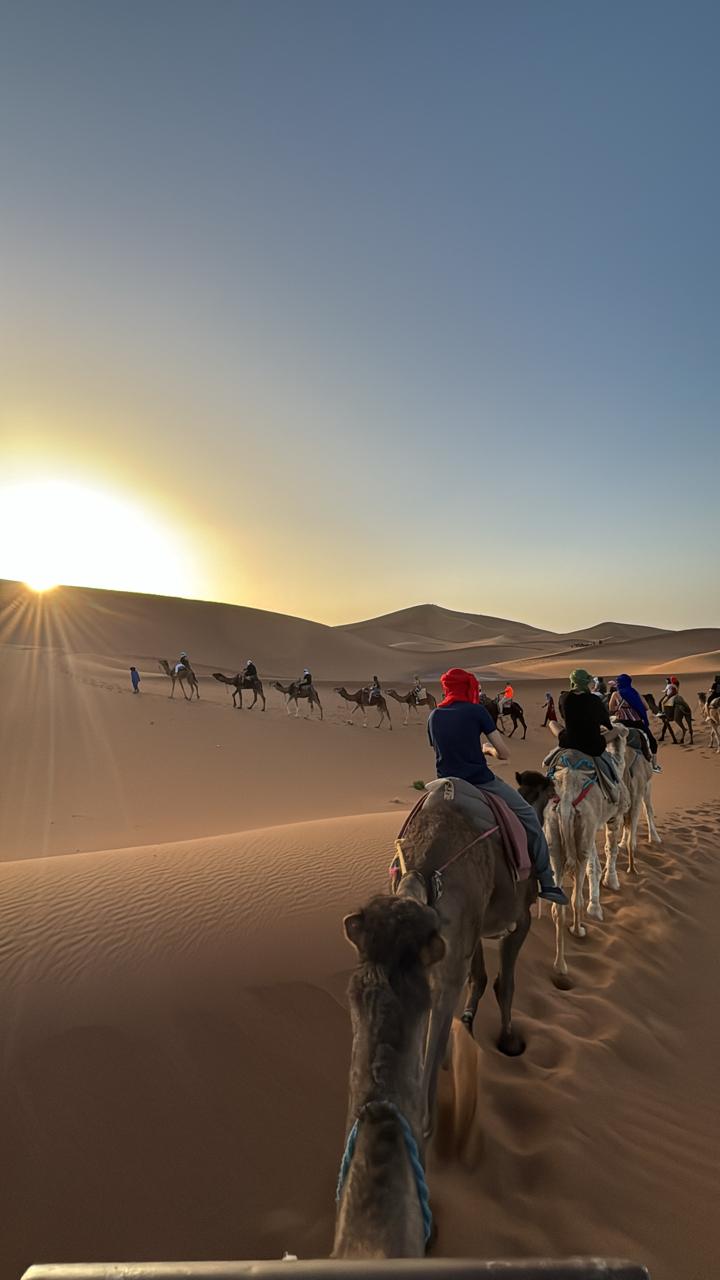
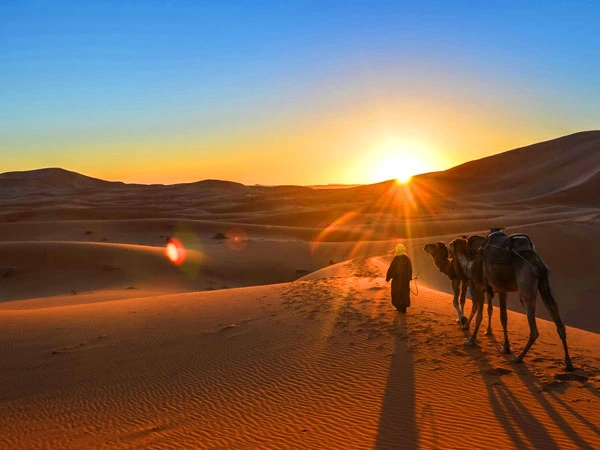
Spring is the best time to visit Morocco desert for camel trekking specifically. The temperatures are ideal for both the camels and the riders, and the golden hour light that comes in the late afternoon — sideways across the dunes, casting long deep shadows — is what most of the iconic Morocco desert photographs are actually taken in.
Cultural festivals happen in spring too. The Sahara Festival in Merzouga and various local moussem events bring Berber music, horse fantasia, and traditional crafts to the desert communities. If this interests you, check dates before booking — they vary year to year.
One thing worth knowing: the Sirocco wind can arrive in spring, carrying fine sand from deeper in the Sahara and reducing visibility. It is not dangerous, but it can be intense for an hour or two. Our guides know how to read the conditions and will adjust itineraries accordingly.
Best spring tours:
- 3-day Zagora to Erg Chigaga desert tour — perfect timing for golden hour dune photography
- 3-day Marrakech desert tour — cross the Atlas in bloom and arrive at the Sahara in ideal conditions
Autumn (September to November) — The Photographer’s Choice
Autumn is equally good for the best time to visit Morocco desert — some of our guides say it is actually better, for reasons that are hard to explain until you experience them.
The temperatures are similar to spring. Daytime sits between 22 and 30°C, nights between 10 and 15°C. Comfortable, clear, and calm. But the light in autumn has a different character. The sun sits lower earlier in the day, which means the golden hour photography window is longer — sometimes stretching for two or three hours in the late afternoon rather than the tight window you get in summer. The shadows on the dunes are longer and more dramatic. Photographers who have been to both spring and autumn often prefer autumn for exactly this reason.
Autumn is also the season when nomadic families are most visible in the deep desert. The brutal summer heat has passed and families who spend the hottest months closer to villages begin moving their herds back through the erg. On longer Erg Chigaga tours in October and November, encounters with nomadic families are more likely than at any other time of year — and with a good guide who knows the community, these moments can become the most memorable part of the trip.
Tourist numbers are lower in autumn than spring — particularly in October, which is one of the quietest months of the year while still offering near-perfect conditions. If you want the desert more to yourself, October is your month.
Best autumn tours:
- 2-day Marrakech to Erg Chigaga desert tour — long golden hours and nomadic encounters
- 3-day camels dunes and nomadic tents tour — autumn is peak season for nomadic family encounters
Winter (December to February) — Crisp Skies and Cold Nights
Winter in the Moroccan desert is something most visitors do not expect to be beautiful. It is. Genuinely, surprisingly beautiful. And for certain travellers — particularly stargazers and photographers — winter is actually their preferred best time to visit Morocco desert.
Daytime temperatures sit between 18 and 22°C — pleasantly warm in the sunshine, comfortable for walking and exploring. The cold arrives after sunset. Desert nights in December and January can drop to 0–5°C, and occasionally below freezing in exposed locations. This is not the romanticised version of cold. It is actual cold. You need proper layers, a warm sleeping setup, and ideally a camp that has thought about heating.
The reward for accepting the cold is the sky. Winter nights in the Moroccan Sahara offer some of the best stargazing conditions on earth. The air is driest in winter, the clarity exceptional, and with tourist numbers at their lowest the darkness around the camps is more complete. Bortle Class 2 conditions — essentially the darkest sky rating available — mean the Milky Way is not just visible but overwhelming. We have had guests spend three hours lying on their backs after dinner, completely silent, just watching.
The daytime landscape in winter has its own drama. Occasional rains between November and February can transform the desert briefly — a thin green fuzz appearing on rocky hammada, the occasional pool of water in a dry riverbed, the dunes looking slightly darker and denser than in summer. It does not last. But catching it is special.
Tourist crowds are minimal in December and January — with the exception of the Christmas and New Year period when the desert fills up quickly and camps book out weeks in advance. If you are visiting in late December, book early.
Best winter tours:
- 2-day Zagora desert tour — clear winter skies make stargazing extraordinary
- 5-day Morocco itinerary — cross snow-capped Atlas Mountains and descend into the golden desert
Summer (June to August) — Is It Worth the Heat?
We are going to be honest with you here, the way we would be honest with a friend.
Summer in the Moroccan Sahara is extreme. Temperatures regularly reach 45°C during the day and have been recorded above 50°C. The ground radiates heat. The air does not move. Standing in the sun between 10am and 5pm is genuinely uncomfortable and can be dangerous — heatstroke and dehydration are real risks, not theoretical ones.
Most experienced desert operators — including us — advise against visiting in July and August unless you have a specific reason to come in summer and know what you are signing up for.
That said, there is a contrarian case for summer that deserves to be made honestly.
Summer is cheap. Significantly cheaper than peak season — some camps reduce rates by 40-50%. It is quiet. The desert in July is about as close to empty as it gets. And the nights — this part surprises people — the summer nights are actually warm and comfortable, sitting around 24-25°C. If you organise your day entirely around the cool hours (pre-dawn and evening), sleeping during the hottest midday hours as the Berber tradition dictates, summer can offer a different kind of desert experience. The golden hour photography is extraordinary. The silence is profound.
But it requires genuine heat tolerance, proper preparation, and experienced guides who know how to manage the conditions. It is not something we recommend for families with children, older travellers, or anyone without prior experience of extreme heat environments.
Regional Variations — Which Desert at Which Time?
The Morocco desert is not one place. Here is how timing affects each main destination differently — because the best time to visit Morocco desert can vary slightly depending on which part of the desert you are heading to:
Erg Chebbi (Merzouga)
The most accessible desert in Morocco, Erg Chebbi sits near Merzouga in eastern Morocco. Its proximity to the Atlas Mountains means it benefits slightly from mountain air circulation — daytime temperatures are typically 2-3°C cooler than Erg Chigaga in summer, and the Sirocco winds that arrive in spring tend to dissipate slightly before reaching the dunes. Good for all seasons. At its best in spring and autumn.
Erg Chigaga
Remote, larger, and hotter. Erg Chigaga sits in the deep south, in an area that receives less moderating influence from mountains or coast. Summer temperatures here are more extreme than Merzouga — this is where the 50°C readings happen. In spring and autumn it is glorious. In winter the remoteness means the stargazing is the best in Morocco. Avoid in July and August unless you know exactly what you are doing.
Agafay Desert
The Agafay is not technically a sand desert — it is a rocky hammada plateau, around 30-45 minutes from Marrakech. The landscape is dramatic but different in character from the great ergs. Visit Morocco lists it as one of the country’s most accessible desert experiences. It is excellent for spring and autumn day trips from Marrakech, and for sunset dinners and glamping experiences that do not require a long drive south. In summer the heat is less extreme than the deeper desert, making it a reasonable option for visitors who want a desert experience without the full commitment of reaching Erg Chigaga or Erg Chebbi.
Best Time by Activity
Knowing the best time to visit Morocco desert is one thing — but the ideal timing can also depend on what you specifically want to do while you are there:
Camel Trekking
October to April. The camels are comfortable, the riders are comfortable, and the light is right. Avoid midday riding in any season — early morning or late afternoon is always the better experience regardless of time of year.
Stargazing
Winter gives you the clearest skies — the driest air, the lowest light pollution from other camps, and the longest nights. But any moonless night from October through April will give you a sky that most people have never seen before. Summer nights are warm enough to lie outside comfortably for hours, which has its own appeal if you can handle the heat during the day.
Sandboarding
Best when the sand surface is cool and firm — early morning in any season, or throughout the day in winter. In summer the sand surface temperature can exceed 70°C and sandboarding becomes genuinely dangerous to skin and equipment.
4×4 Expeditions
Autumn (October-November) is ideal for long 4×4 expeditions into the deep desert. The temperatures are manageable, the ground conditions are good after the summer, and the nomadic communities are moving through the desert which adds an extra layer of experience to longer routes.
Photography
Autumn for the longest golden hours and most dramatic shadows. Spring for the blooms and festival atmosphere. Winter for the star trails and frost-cleared air. Summer for the heat haze abstract landscapes that require a specific eye but produce extraordinary images.
Best Time by Departure City
The best time to visit Morocco desert also depends on where you are starting your journey from. Here is how timing affects each departure city:
From Marrakech
Spring is magical — crossing the High Atlas when the mountains are still partly snow-capped and descending into a desert that is warm but not brutal. Autumn is equally spectacular. The drive through the Dades Gorge in October light is one of the more beautiful journeys in Morocco.
👉 3-day Marrakech desert tour — perfect for spring and autumn visits
From Zagora
Zagora sits at the edge of the Sahara and is warm year-round. The town itself becomes very hot in summer but the desert tours from Zagora can be adapted for any season — early morning starts in summer, full-day itineraries in spring and autumn.
👉 Overnight Zagora desert experience — ideal year-round with flexible morning start times
From Fez
The road from Fez to the desert crosses the Middle Atlas — which means in winter you are driving through cedar forests that may have snow. It is stunning but adds time and requires care on mountain roads. Spring and autumn are the ideal seasons for this route.
👉 3-day Zagora to Erg Chigaga tour — combine Fez with the deep desert in spring or autumn
From Casablanca
The long Casablanca itineraries work well in spring and autumn when the variety of landscapes — coast, mountains, valley, desert — are all at their seasonal best simultaneously. In winter the contrast between the grey Atlantic coast and the golden desert is dramatic in its own way.
👉 5-day Morocco itinerary — the perfect length to experience coast, mountains and desert in one trip
Essential Planning — What the Tour Operators Won’t Always Tell You
Once you have decided the best time to visit Morocco desert for your situation, here is the practical information most travel sites do not cover honestly:
How to Book
Book directly with a locally-based operator rather than through a generic aggregator platform if possible. Large booking platforms bundle desert tours with standardised itineraries that often rush the experience — one night in the desert is not enough to really feel it, and many platform tours are designed around what is logistically convenient rather than what is experientially meaningful.
Two to three nights in the desert is the minimum for real immersion. One night gives you a sunset and a sunrise. Two nights gives you that and the silence of a full desert night, the stars without the adrenaline of arrival, and the slower rhythm of Berber desert life starting to feel familiar.
We are genuinely not saying this just to sell longer tours. One-night guests almost universally wish they had stayed longer. It is one of the most consistent pieces of feedback we receive.
Getting There
Three realistic options depending on your priorities:
Private transfer — most comfortable, most flexible, most expensive. Your guide picks you up, you stop where you want, you arrive when it makes sense. The right choice for families, older travellers, and anyone for whom the journey quality matters.
Supratours bus — the budget option. Regular services from Marrakech to Ouarzazate and onward. Cheap, reasonably reliable, but long and inflexible. Good for solo travellers on a tight budget who do not mind the time.
Rental car — freedom and flexibility. Works well for confident drivers familiar with Moroccan road conditions. Not recommended for the off-road sections to Erg Chigaga — you need a specialist 4×4 for that section regardless of what you drive to M’Hamid.
Duration
Two to three days minimum. Here is the honest breakdown of what you actually experience at each duration:
1 night — you arrive, see the sunset, sleep in the desert, see the sunrise, leave. Beautiful but brief.
2 nights — you have time to breathe. The second night in the desert is when most people say it clicked. The novelty has passed and what remains is genuine presence.
3 nights and beyond — for Erg Chigaga especially, three nights allows for real exploration of the dune system, encounters with nomadic families, and the kind of experience people spend years trying to describe to friends who were not there.
Packing Checklist by Season
Universal — Bring These Any Time of Year
A good quality scarf or cheche is the single most useful item in the desert — it protects from sun, sand, wind, and cold depending on how you wear it. High-SPF sunscreen (50+) applied generously and often. Proper sunglasses that seal around the eyes rather than just sitting on the bridge of the nose. A reusable insulated water bottle — hydration in the desert is not optional. Comfortable closed walking shoes for dune walking.
Winter Additions
Thermal base layers that you can pack small but that make a genuine difference at 2°C. A warm fleece or down jacket for evenings and early mornings. Gloves — genuinely necessary in December and January, not just a comfort item. A sleeping bag liner if you want extra warmth in the camp tent.
Summer Additions
Electrolyte sachets — essential for replacing what you lose in the extreme heat. Loose, light-coloured long-sleeved shirts that protect skin from the sun while allowing airflow. A personal cooling cloth or small portable fan for the midday rest period. Extra water capacity beyond what you think you will need.
Frequently Asked Questions
When is the best time to visit Morocco desert for families? Spring and autumn are ideal for families — temperatures are comfortable for children, camel trekking is manageable, and the days are long enough to explore without rushing. Avoid summer with young children due to extreme heat.
Does it rain in the Sahara desert Morocco? Yes, but rarely. Annual rainfall in the Moroccan Sahara averages between 25 and 100mm depending on location — for context, London gets around 600mm per year. According to the Morocco Meteorological Directorate, most rain falls between November and February. When it does rain, the desert transforms briefly and dramatically — worth seeing if you catch it.
How cold does it get at night in the Morocco desert? Winter nights in the desert regularly drop to 0–5°C and occasionally below freezing. Summer nights stay warm at around 24–25°C. Spring and autumn nights range from 10–18°C — cool enough to sleep well, warm enough to sit outside comfortably.
Can I visit the Morocco desert during Ramadan? Yes. The desert experience itself is largely unaffected. Guides and camp staff observe the fast, which means schedules may adjust slightly — later starts to the day, larger meals after sunset. Some restaurants in towns along the route may be closed during daylight hours. We recommend being respectful of the fast and planning meals accordingly. In some ways Ramadan adds a dimension to the cultural experience that is worth being present for.
Is the Morocco desert safe for solo female travellers? Yes — Morocco and the desert regions are generally safe for solo female travellers. The desert communities are welcoming and guides are professional. The standard advice applies: book with a reputable operator, share your itinerary with someone at home, and use your normal judgement. Many of our solo guests are women and the consistent feedback is positive.
What is the difference between Erg Chigaga and Erg Chebbi in terms of weather? Erg Chigaga tends to be 2–3°C hotter than Erg Chebbi in summer due to its greater distance from the Atlas Mountains and the coast. In spring, autumn and winter the difference is minimal. Erg Chigaga is generally windier — the open terrain means less shelter from the Sirocco. Both offer exceptional conditions during the October–April window. Read our full comparison →
How far in advance should I book? For spring (March–May) and the Christmas/New Year period: at least 4–6 weeks ahead, ideally more. For autumn and winter: 2–3 weeks is usually sufficient outside of school holiday periods. For summer: last-minute booking is usually possible given lower demand.
The Final Verdict — When Should You Go?
If you can choose freely, March and October are the two best individual months — the absolute best time to visit Morocco desert in our experience. March combines ideal temperatures, spring light, and the energy of post-winter opening. October combines perfect photography conditions, nomadic activity in the deep desert, and enough quiet that you can have significant sections of Erg Chigaga more or less to yourself.
If you cannot choose freely, do not let the month stop you. The Sahara is extraordinary in all seasons. Winter gives you the stars. Summer gives you the challenge and the quiet. The desert does not have a bad time to visit — only better and less-better times, and even the less-better ones tend to produce the kind of memories that stay with people for years.
We have watched people arrive at the desert in every month and we have never once seen someone leave unchanged.
Still not sure when your trip works best? Drop us a message and we will help you find the right timing for your specific situation — no obligation, just honest advice from people who are here year-round.
👉 Browse our Morocco desert tours 👉 Contact us | 📞 +212 678-444071
More from the blog: Erg Chigaga vs Erg Chebbi — Which Desert Should You Visit in 2026? → · What to Expect on a Morocco Desert Tour → · Morocco Desert Packing List → · How to Get to Erg Chigaga → · Complete Guide to Morocco Desert Tours →