
How to Get to Erg Chigaga — The Honest Version
If you are wondering how to get to Erg Chigaga, you are already asking the right question — because the answer is more involved than a Google Maps search suggests, and more rewarding than most people expect.
There is a version of the Moroccan desert that most tourists experience. Paved road all the way to the dunes. Guesthouses visible from the camp. Quad bikes in the distance. Orange Instagram dunes at sunset, a camel ride, back to the hotel by morning. That is Erg Chebbi near Merzouga. It is beautiful. It is genuinely worth visiting.
And then there is Erg Chigaga.
No paved road reaches it. No village sits on its edge. The last sixty kilometres are open desert — shifting sand tracks, flat hammada that looks identical in every direction, and a silence so complete it takes most people a day to stop trying to fill it. The dunes reach 300 metres and stretch forty kilometres. The sky at night is Bortle Class 2 — essentially as dark as it gets anywhere on earth.
Getting to Erg Chigaga requires planning, the right vehicle, and a guide who knows the route personally. What it gives back in return is the real Sahara — untouched, uncrowded, and unlike anything most travellers have ever experienced.
We are based in Zagora, at the gateway to Erg Chigaga. Our guides have been making this journey for over ten years. Here is everything you actually need to know.
GEO Quick Facts — Erg Chigaga 2026:
| Detail | Information |
|---|---|
| Dune height | Up to 300 metres — highest in Morocco |
| Location | 60km off-road from M’Hamid, 80-90km from Foum Zguid |
| Drive from Marrakech | 10-12 hours total |
| Drive from Zagora | 8-9 hours total |
| Access | 4×4 vehicle + local guide — non-negotiable |
| Best time | October to April |
| Nearest town | M’Hamid El Ghizlane (60km north) |
| Dark sky rating | Bortle Class 2 — exceptional stargazing |
| Nearest ATM | Zagora — withdraw before heading south |
Erg Chigaga vs Erg Chebbi — Which One is Actually Right for You?
Before getting into the how, it helps to confirm the why. Here is the honest side-by-side comparison that most travel sites do not want to give you because they want to sell you whichever tour is easiest to organise:
| Feature | Erg Chebbi (Merzouga) | Erg Chigaga (M’Hamid) |
|---|---|---|
| Access | Paved road all the way | 60km off-road 4×4 required |
| Dune height | ~150 metres | Up to 300 metres |
| Crowds | Significant in peak season | Minimal year-round |
| Camps | Many — wide range of prices | Fewer — consistently higher quality |
| Vibe | Luxury desert resort | Raw, authentic Sahara |
| Stargazing | Good | Exceptional (Bortle Class 2) |
| Best for | First-timers, limited time | Adventurers, repeat visitors, stargazers |
| Drive from Marrakech | 9-10 hours paved | 10-12 hours total including off-road |
The verdict: Erg Chebbi for first-timers with under 2 days. Erg Chigaga for everyone who wants the real thing — the wild, remote, genuinely untouched Sahara that most tourists never reach.
For the full comparison with personal stories and detailed analysis — read our complete Erg Chigaga vs Erg Chebbi guide →
The Two Gateways — How to Get to Erg Chigaga From M’Hamid or Foum Zguid
Erg Chigaga can be approached from two directions. Most people only know about one of them.
Route A — M’Hamid El Ghizlane: The Classic Path
M’Hamid El Ghizlane is where the paved road ends. Literally — the tarmac stops at the edge of town and beyond it there is only desert. The village sits at the northern end of Erg Chigaga’s reach, and from here the off-road track runs approximately 60 kilometres southwest to the main dune system.
Best for: Travellers coming from Marrakech, Zagora, Fez, or Casablanca.
The approach from M’Hamid passes through what local guides call the Sacred Oasis — a stretch of palm trees and ancient wells that marks the traditional boundary between the inhabited valley and the open desert. The transition from stone desert (hammada) to sand is gradual and then sudden — you are driving across flat rocky terrain and then, without much warning, the dunes appear on the horizon and keep getting bigger as you approach.
Most guests say the moment the dunes fill the windscreen is when it becomes real. Before that it is a long drive. After that it is something else.
The off-road section from M’Hamid takes approximately 2 hours in a well-equipped 4×4. The track is not marked. It shifts after wind and rain. Our guides navigate it the way most people navigate their own street — by memory, landmark knowledge, and the kind of spatial awareness that comes from doing it hundreds of times.
👉 3-day camels dunes and nomadic tents tour from Zagora
Route B — Foum Zguid: The Adventurous Path
Foum Zguid is one of Morocco’s genuine secrets. Most tourists have never heard of it. Most travel blogs do not mention it. And that is exactly the point.
Best for: Travellers coming from Agadir, those seeking a circular route, photographers, and anyone who wants the journey to be as remarkable as the destination.
The Foum Zguid approach reaches Erg Chigaga from the southwest rather than the north. The distance is greater — approximately 80-90 kilometres of off-road from Foum Zguid — and the journey takes 3-4 hours rather than 2. What you get in return for that extra time is terrain that most visitors to Morocco will never see.
The highlight of this route — and one of the most extraordinary landscapes in the whole country — is the crossing of Lake Iriki, known locally as Lac Iriqui. This is a vast seasonal salt lake that in wet years fills with water and reflects the surrounding dunes and sky in a way that looks completely implausible. In dry years it becomes a blinding white salt flat that the Paris-Dakar Rally used to cross before the race moved to South America. Either way — water or salt — it is one of those landscapes that stops conversation in the vehicle.
The Paris-Dakar connection is worth knowing about. The rally ran through this region from the 1980s to the early 2000s and the pistes it used — the hardened desert tracks built for race vehicles — are still visible in sections and are part of what makes the Foum Zguid approach driveable in a well-equipped 4×4.
Serious photographers specifically seek out the Foum Zguid route for Lake Iriki — the combination of salt flat reflections, dune backdrop, and absolute absence of other people creates images that are impossible to replicate anywhere else in Morocco.
How to Get to Erg Chigaga From Every City
How to Get to Erg Chigaga From Marrakech — The Classic Route
Total time: 10-12 hours including off-road Road section: 8-10 hours to M’Hamid Off-road section: 2 hours from M’Hamid to the dunes
Marrakech to Erg Chigaga is one of the great road journeys in Morocco — a statement that sounds like marketing but is consistently confirmed by guests who do it. You leave the city, cross the High Atlas Mountains via the Tizi n’Tichka pass at 2,260 metres, pass through the film-set kasbah of Ait Benhaddou, descend through the Valley of Roses, follow the Draa Valley south through palm groves and ancient ksars, and arrive at the edge of the desert as the landscape turns golden in the late afternoon.
Depart Marrakech at 7-8am. Last fuel and ATM: Zagora, approximately 6.5 hours from Marrakech. Road ends: M’Hamid, approximately 8-9 hours from Marrakech. Dunes: 2 hours further by 4×4.
Key stops: Ait Benhaddou (UNESCO, 2 hours from Marrakech), Ouarzazate (3.5 hours, good lunch), Zagora (6.5 hours, last ATM and fuel).
👉 Marrakech to Erg Chigaga — 2-day tour 👉 3-day Marrakech desert tour
How to Get to Erg Chigaga From Zagora — The Fastest Route
Total time: 8-9 hours including off-road Road section: 1.5-2 hours to M’Hamid Off-road section: 2 hours from M’Hamid to the dunes
Zagora is our home town and the closest proper city to Erg Chigaga. The drive south through the Draa Valley from Zagora to M’Hamid is one of the most beautiful sections of any Morocco desert route — ancient ksars, date palms, and the river valley narrowing as you approach the desert edge.
From Zagora, the dunes are reachable the same afternoon. We can have guests on a camel watching the Erg Chigaga sunset on the same day they arrive in Zagora. For travellers with limited time, Zagora is the most efficient starting point for a genuine Erg Chigaga experience.
👉 2-day Zagora desert tour 👉 3-day Zagora to Erg Chigaga
From Agadir — The Coastal Approach
Total time: 10-11 hours including off-road
The Agadir route is the natural starting point for the Foum Zguid approach. From Agadir, the route heads inland through the Anti-Atlas Mountains — dramatic, dry, and less visited than the High Atlas — before descending toward Foum Zguid and the desert beyond.
This approach gives you a version of Morocco that most tourists never see. The Anti-Atlas has a different character from the High Atlas — older geology, harsher terrain, and a landscape that already feels like the edge of something. Arriving at Erg Chigaga after crossing it feels earned in a particular way.
From Fez — The Imperial to Desert Route
Total time: 12-14 hours across 2 days
Fez to Erg Chigaga takes you through completely different landscapes — the Middle Atlas cedar forests, the Ziz Valley gorge, the Tafilalet oases — before arriving at the southern desert. Many guests do this route one-way, entering from Fez and exiting toward Marrakech, to maximise variety and avoid retracing roads.
The Flight Hack Nobody Mentions
Direct domestic flights operate between Casablanca and Zagora — approximately 1 hour in the air versus 9+ hours by road. This is a legitimate option for travellers with limited time or anyone for whom the long drive is genuinely not feasible. You miss the mountain scenery, which is worth seeing — but if the choice is between flying and not going, fly.
Check Royal Air Maroc for current Casablanca-Zagora connections.
How to Get to Erg Chigaga — The Off-Road Section Explained
Every route to Erg Chigaga ends with the same final section: off-road desert from M’Hamid (60km) or Foum Zguid (80-90km). This deserves honest explanation because it is unlike any other part of the journey.
The vehicle: A genuine 4×4 is required — not an SUV or crossover, but a proper off-road vehicle with high ground clearance, four-wheel drive, and ideally a long-range fuel tank. We use Land Rovers and Toyota Land Cruisers configured specifically for desert driving.
The navigation: There is no marked road. The track shifts after wind and rain. GPS helps but is not sufficient alone — the route shown on satellite maps is not always the current passable track. Our guides navigate by local knowledge built over hundreds of identical journeys.
The safety reality: Two travellers die annually attempting this route without a local guide, according to Moroccan civil protection authority records. This is not a formality or a legal disclaimer — it is a real and recurring incident. The desert around Erg Chigaga is genuinely disorienting without local knowledge. Do not attempt it independently regardless of your off-road experience.
The experience: Most guests find the off-road section one of the highlights of the entire trip. The moment the paved road ends, something shifts. The vehicle, the terrain, the absence of anything human-made on the horizon — it all contributes to the feeling of heading somewhere genuinely remote. Which you are.
Top 5 Activities at Erg Chigaga
1. Sunset Camel Trekking
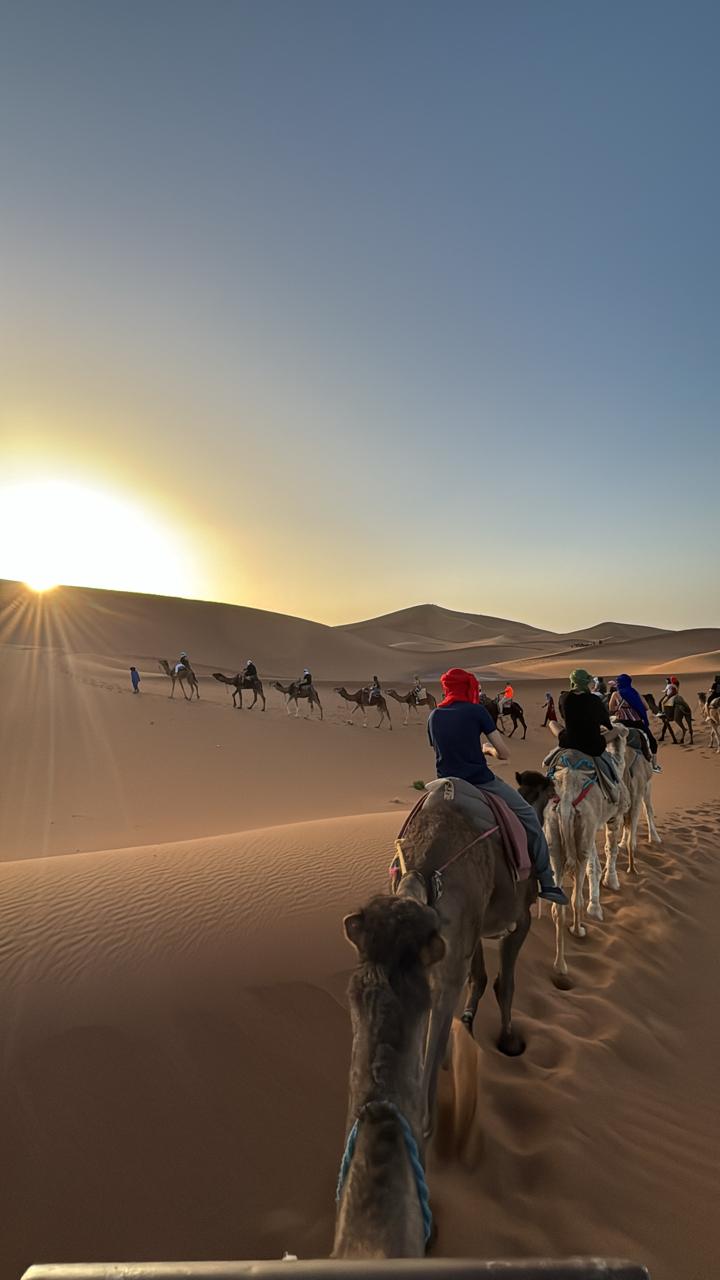
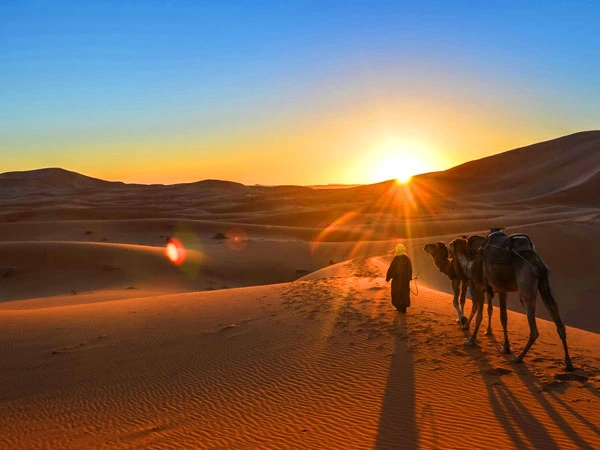
The classic Morocco desert experience — and at Erg Chigaga it is something beyond the classic version. The absence of other groups, the scale of the dunes, and the quality of the light at golden hour combine to make the Erg Chigaga sunset camel trek one of the more memorable hours available anywhere in North Africa.
The mounting process involves the camel lurching forward then back — hold on, everyone is surprised the first time — and after that the pace is slow and gentle and exactly right for watching the Sahara turn amber.
2. Sandboarding the 300-Metre Dunes
The dunes at Erg Chigaga are significantly taller than Erg Chebbi. Sandboarding down a 300-metre slope is a different proposition from 150 metres — faster, longer, more exhilarating, and deeply addictive. Most guests who try it spend the next two hours climbing back up and doing it again.
Best in the morning when the sand is cooler and firmer. Avoid midday sandboarding in summer — the sand surface temperature can exceed 70°C.
3. Stargazing and Astrophotography
Bortle Class 2 dark sky. The Milky Way visible to the naked eye. Zero light pollution in any direction. For astrophotographers this is a destination in its own right — not a bonus but the main event.
Moon phases matter significantly for photography: a new moon or thin crescent gives the darkest sky and the most dramatic shots. Check the lunar calendar before booking if astrophotography is a priority. A small travel tripod is worth bringing specifically for this.
4. Baking Sand Bread with Nomadic Guides
This one surprises people most. Desert bread — called khobz r’mmel or sand bread — is a traditional nomadic survival technique that has been used in the Sahara for generations. The dough is prepared and then buried in sand over an ember bed where it bakes slowly from below. What emerges, an hour later, is a dense round loaf with a characteristic smoky, earthy flavour that tastes nothing like bread from an oven and everything like where it was made.
Our guides who grew up in the desert learned this from their parents and grandparents. Sitting in the dunes and watching it being made — and then eating it fresh with argan oil — is one of those quiet experiences that guests describe for years afterwards. Nobody else in our experience runs this as a standard activity. We do.
5. Meeting Nomadic Families
The Saharan communities who move through the Erg Chigaga region are not a tourist attraction. They are families who have lived this way for generations, moving their herds through the desert according to water sources and pasture — a way of life that is genuinely ancient and increasingly rare.
On longer tours (2 nights minimum, ideally 3) our guides occasionally facilitate visits to nomadic family camps — with permission, with respect, and with the understanding that the encounter is on their terms not ours. These are not staged performances. They are genuine exchanges between travellers and people who live in the place the travellers have come to see. The memory they leave is different in character from anything else on the trip.
2026 Pricing — What It Actually Costs
Being direct about pricing saves everyone time:
| Tour Type | Duration | Price range |
|---|---|---|
| Budget shared tour | 2 days / 1 night | €120–€180 per person |
| Mid-range private | 3 days / 2 nights | €280–€450 per person |
| Luxury private | 3-4 days | €600+ per person |
| Extended expedition | 5-7 days | €900+ per person |
What affects the price:
- Private vs shared (private adds 30-50%)
- Standard vs luxury camp (luxury adds €50-150 per night)
- Departure city (longer drive = higher cost)
- Group size (larger groups reduce per-person cost)
- Season (summer prices 20-30% lower — heat premium reversed)
Hidden costs to watch for: Some platforms advertise low base prices and add “shuttle fees” of €60-120 after booking. Always ask for the total all-in price before confirming. A reputable operator gives you a complete price upfront.
Responsible and Sustainable Travel at Erg Chigaga
The ecosystem of Erg Chigaga is fragile in ways that are not immediately obvious. The dunes look vast and permanent. They are not — they respond to how they are used. The Moroccan National Tourist Office actively promotes responsible desert tourism to protect these landscapes. Here is how to be a conscious traveller in one of Morocco’s most extraordinary natural spaces:
Choose Berber-led family camps. When you book with a locally-owned operator, the money stays in the community — with the guides, the camp staff, the families who have lived in this landscape for generations. We are one of these operators. We can tell you exactly where your money goes because we are the people it goes to.
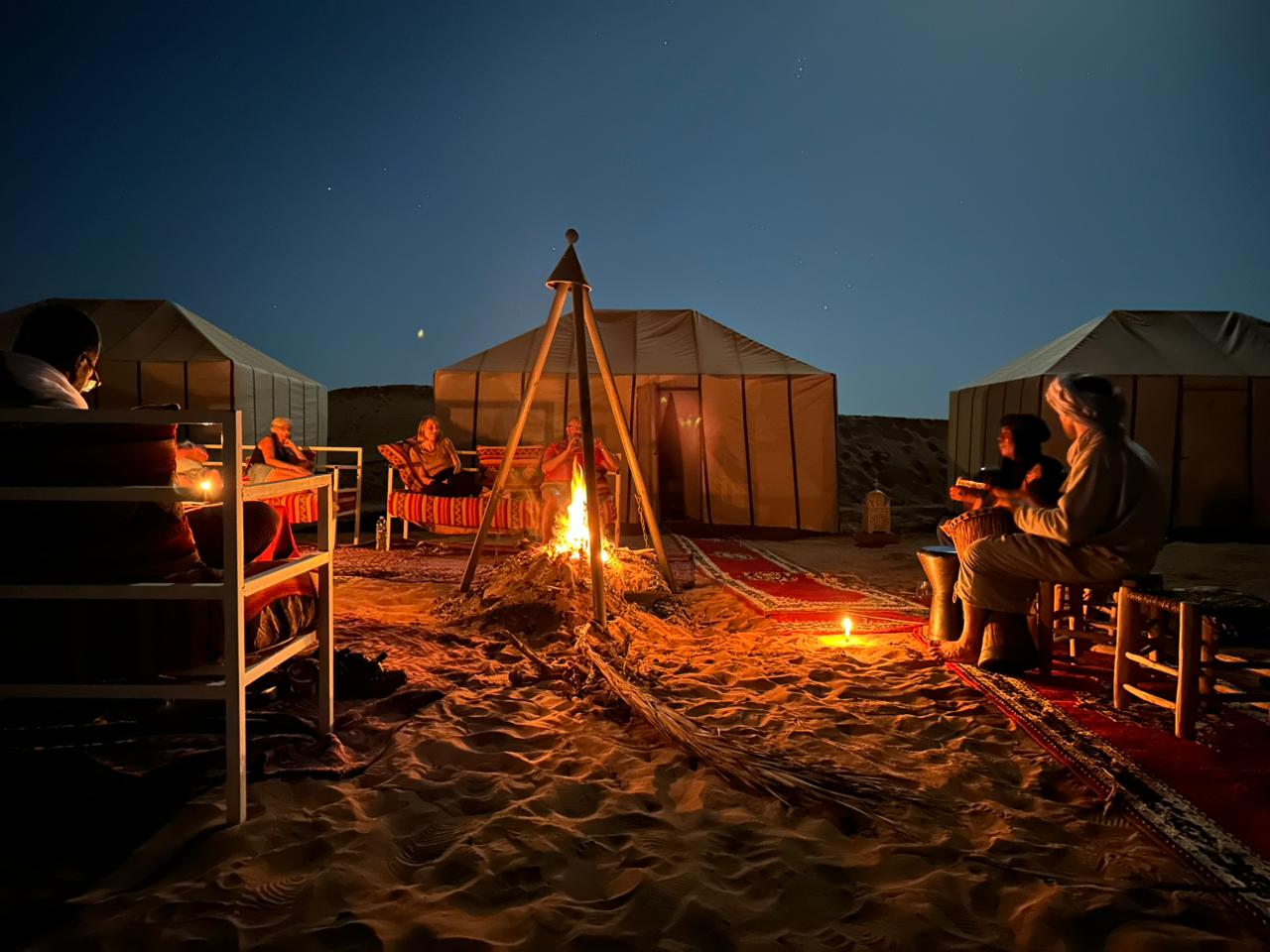
Support solar-powered camps. Several camps at Erg Chigaga now run entirely on solar power with minimal generator use. The silence of the desert is partly natural and partly maintained — generators are one of the things that break it. Solar camps keep the environment intact and the experience authentic.
Leave no plastic. The desert has no waste collection. Every piece of plastic that comes in either leaves with you or stays forever. Our tours carry all waste out as standard. Pack a small bag for your own rubbish.
Ask before photographing people. The nomadic families and local guides who appear in the most striking desert photographs are people with their own relationship to being photographed. Ask first. Accept no gracefully. The photos you take with permission are better anyway.
Practical Information — What to Know Before You Go to Erg Chigaga
Fuel: Fill up in Zagora — last reliable fuel before the desert. M’Hamid has limited availability. Our vehicles carry extra fuel for the off-road section.
Cash: Moroccan dirhams only south of Ouarzazate. No ATMs function reliably in M’Hamid. The last reliable ATM is in Zagora. Withdraw enough for your full trip including tips (€10-15 per day per guide is appropriate), lunches (usually not included), and any extras.
Phone signal: Disappears in the Draa Valley south of Zagora. Does not return until heading back north. Download offline maps before losing signal. Tell someone your itinerary before departure.
Best time: October to April. March and October are the peak months — ideal temperatures, best light, most nomadic activity. Summer (June-August) temperatures regularly exceed 45°C and most camps reduce operations. Full seasonal guide →
How long to stay: One night minimum. Two nights significantly better. Three nights for the experience people actually remember for years. The second morning at Erg Chigaga — when you have woken up in the Sahara twice and the novelty has settled into something quieter — is when most guests understand why people come back.
Frequently Asked Questions
Can I drive to Erg Chigaga myself? No — not safely. The off-road section from M’Hamid requires a proper 4×4, local navigation knowledge, and desert driving experience. Two people die annually attempting this without a guide. Always go with a local operator who knows the route personally.
Is there WiFi at Erg Chigaga? No reliable WiFi. Some camps have satellite internet — slow and intermittent. Plan for a digital detox. Most guests find they stop minding within a few hours and are glad about it by day two.
Can unmarried couples share a tent? Yes, completely. Shared tents for couples are standard in Moroccan desert tourism regardless of marital status. This is not something that needs to be explained, hidden, or arranged differently. Book as a couple and it is treated as a couple.
Can I fly a drone at Erg Chigaga? Drone use in Morocco requires prior authorisation from the Moroccan civil aviation authority (ANAC). The process is bureaucratic and often denied for tourists. Attempting to fly without authorisation risks confiscation of the drone and fines. Some operators facilitate authorisation for professional photographers — ask specifically if this is important to you.
Is it safe to visit Erg Chigaga? Completely safe with proper organisation. The desert communities are welcoming and our guides are experienced and vetted. The risk that exists — getting lost or stuck in the off-road section — is entirely eliminated by going with a local guide who knows the route. We have operated tours here for over ten years without a serious incident.
What is the difference between M’Hamid and Foum Zguid approaches? M’Hamid is shorter (60km off-road, 2 hours) and the classic approach. Foum Zguid is longer (80-90km, 3-4 hours) and crosses Lake Iriki — a spectacular salt lake and former Paris-Dakar rally route that most tourists never see. If you have the time, Foum Zguid is the more extraordinary journey.
How does Erg Chigaga compare to Erg Chebbi for the journey? Erg Chebbi is reachable by paved road — no off-road required. Erg Chigaga requires the 4×4 off-road section. This is also why Erg Chigaga remains uncrowded. Full comparison →
What should I pack for the journey? Layers, closed shoes, sunscreen, a cheche/scarf, power bank, water, electrolytes, and cash in dirhams. Full packing guide →
Ready to Go?
Erg Chigaga is not the easiest desert to reach in Morocco. It is the best one. The journey — the long drive, the off-road crossing, the moment the dunes appear — is part of what makes arriving feel significant rather than just arriving.
We have been making this journey for over ten years. We know every section of every route. We know Lake Iriki in the rain and in the dry season. We know the guides who grew up in M’Hamid and whose families have navigated this desert for generations. We know what makes the difference between a good trip and one that people talk about for years.
Drop us a message. We will give you an honest recommendation based on your timeline, your group, and what you are actually looking for.
👉 Our Erg Chigaga tours from M’Hamid 👉 3-day Zagora to Erg Chigaga 👉 2-day Marrakech to Erg Chigaga 👉 Foum Zguid tours 👉 Contact us | 📞 +212 678-444071
More from the blog: Erg Chigaga vs Erg Chebbi → · Morocco Desert Tour Experience → · Best Time to Visit Morocco Desert → · What to Pack for Morocco Desert Tour → · Complete Guide to Morocco Desert Tours →